
The lock that sounds most secure isn’t always the right fit. The different types of locks work in different ways, and the right choice depends on where you’ll use one and who needs access. To narrow your options, start with the door, vehicle, or business you need to secure.
You don’t need to memorize every lock name to make a practical choice. This guide explains how common lock types differ, where they’re typically used, and what to consider before choosing one. You’ll learn the basics of deadbolts, knob and lever locks, mortise locks, smart locks, and common vehicle locking systems.
We’ll also cover how to weigh security, convenience, and the needs of people using the space. If a lock is damaged, keys are missing, or you’re locked out, a local locksmith can help with installation, rekeying, or emergency access. Two Keys Mobile provides mobile locksmith service in Little Rock and surrounding Central Arkansas communities. By the end, you’ll have a clearer way to match a lock to your situation and know when on-site help makes sense.
Key Takeaways
- Compare the different types of locks by separating their physical format, internal mechanism, and access method.
- Use the setting and access needs to narrow down suitable options for home doors, businesses, vehicles, and portable uses.
- Follow a five-step checklist to identify the opening, review existing hardware, and plan the installation.
- Recognize when a house lockout, new lock installation, or rekeying may call for on-site locksmith help.
- See how a mobile locksmith can support practical lock needs across Little Rock and surrounding Central Arkansas communities.
Different types of locks: identify the lock by where it is used
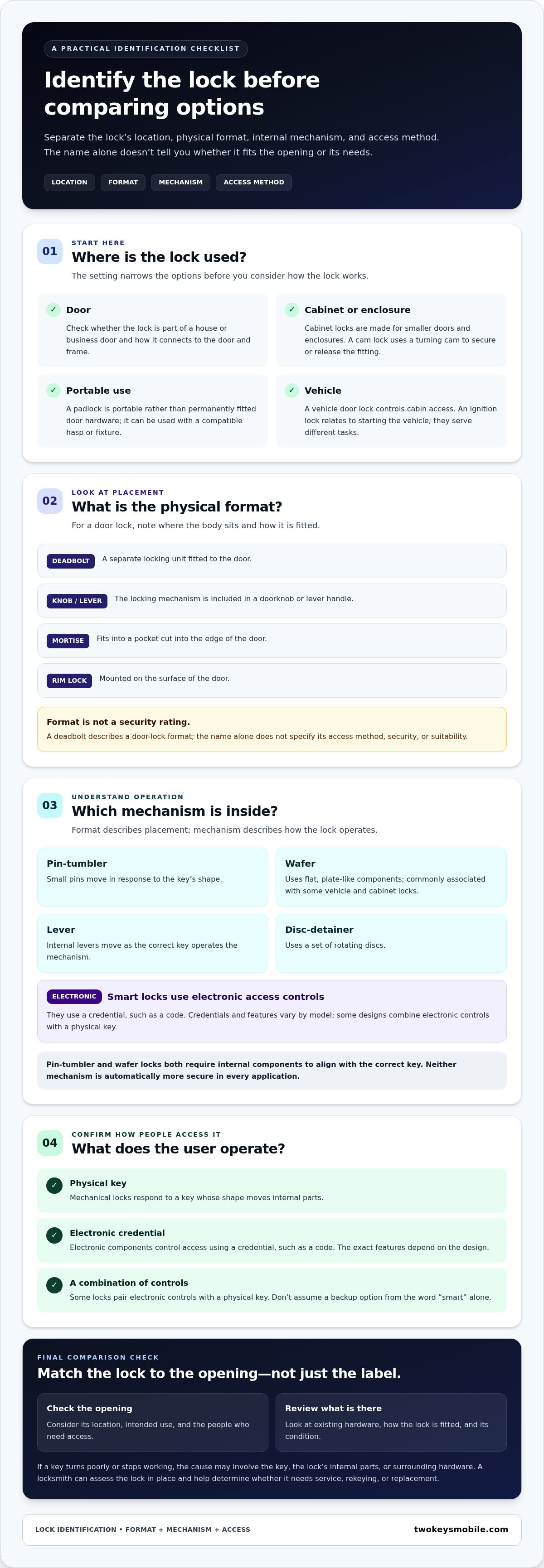
Lock names can describe different things. A format is the lock’s physical shape and how it fits the opening. A mechanism is the internal arrangement that allows or prevents it from opening. An access method is what a person uses, such as a key or code. Those three details help you identify what kind of lock you’re looking at and compare options more accurately.
Start with the location. Is the lock fitted to a house door, attached to a cabinet, used as portable security, or built into a vehicle? That first distinction narrows the options before you consider the mechanism. For a broad overview of the history and types of locks, see Wikipedia’s reference on locks. Here, the focus is on recognizing familiar formats in everyday settings.
Keep the categories separate as you compare. A deadbolt, for example, describes a door-lock format; it doesn’t, by itself, tell you whether the lock uses a key or another access method. Likewise, two locks with similar-looking hardware may use different internal mechanisms. The lock’s name alone doesn’t establish its security or suitability. The opening, existing hardware, condition, and intended use all matter.
Which lock types are commonly found on doors?
Deadbolts are fitted to doors as a separate locking unit. Knob locks include a locking mechanism in the doorknob, while lever-handle locks place the handle in a lever. A mortise lock fits into a pocket cut into the door edge. A rim lock is mounted on the door’s surface. These names describe formats, not a complete security rating.
To identify a door lock, look at where its body sits and how it connects to the door and frame. Note whether it’s built into the knob or lever, set into the door edge, or mounted on the surface. Also look at how the lock operates and whether it’s paired with other hardware. These details help distinguish formats that may otherwise be easy to mix up. Suitability depends on the opening and its needs, not just the label.
Where do padlocks, cabinet locks, and vehicle locks fit?
Padlocks are portable. They aren’t permanently fitted door hardware and can be used with a compatible hasp or other fixture. Cabinet locks are designed for smaller doors and enclosures. A cam lock is one example: its turning part, or cam, moves to secure or release the fitting. These formats suit specific installations rather than serving as general door-lock categories.
Vehicles have distinct locks for distinct tasks. A door lock controls access to the vehicle cabin, while an ignition lock relates to starting the vehicle. Don’t treat them as interchangeable just because both may use a key or credential. Identifying the location and function first makes it easier to describe the lock accurately and compare the right options for the job.
How common lock mechanisms work: pins, wafers, levers, and electronics
A lock’s mechanism is the internal arrangement that allows or prevents it from opening. It’s separate from the lock’s shape and where it’s installed. Lock format describes placement; mechanism describes operation. That distinction makes it easier to compare the different types of locks without treating every lock name as a different operating principle.
Mechanical locks respond to a physical key. The key’s shape moves internal parts into a position that lets the lock operate. Electronic locks instead use a credential, such as a code, to control access through electronic components. Some locks combine electronic controls with a physical key, but designs and features vary. Don’t assume a particular access method, backup option, or level of security from the word “smart” alone.
What is the difference between pin-tumbler and wafer locks?
Both mechanisms use internal components that must align with the correct key for the lock to operate. In a pin-tumbler design, small pins move in response to the key’s shape. A wafer mechanism uses flat, plate-like components instead. The internal layouts differ, but neither design is automatically more secure in every application. Wafer mechanisms are commonly associated with some vehicle and cabinet locks.
For a reader, the useful point is how the lock functions, not how to take it apart. If a key turns poorly or stops working, the cause may involve the key, the lock’s internal parts, or the surrounding hardware. A locksmith can assess the lock in place and help determine whether it needs service, rekeying, or replacement.
How do lever, disc-detainer, and smart locks differ?
Lever locks use internal levers that move as the correct key operates the mechanism. Disc-detainer locks use a set of rotating discs. Both are mechanical approaches, but their internal components and key designs differ. Smart locks use electronic access controls rather than relying only on a mechanical key. Depending on the model, credentials and operating features can vary, so the category name alone doesn’t tell you exactly how access works.
Electronic controls don’t remove the need to consider how people exit through a door. For relevant life-safety guidance, consult the NFPA 101 Life Safety Code. The appropriate hardware depends on the opening and its use, especially in commercial spaces where door function and occupant safety matter alongside access control.
Use mechanism terms as a starting point, not a final verdict. Identify the opening, how the lock is operated, and what problem you need to solve. If a residential or commercial door needs a new lock or a rekey, Two Keys Mobile provides mobile locksmith service in Little Rock and surrounding Central Arkansas communities. Learn about residential lock installation and rekeying for help matching the hardware to the door.
Compare lock types by use: home doors, businesses, and vehicles
A lock that suits one opening may be a poor match for another. Compare the different types of locks by considering the door or fitting, how people use it, and the lock’s intended role. A home entry door, an interior room, and a business access point can have different hardware and access needs, even if their locks share a familiar name.
Assess a lock in the context of its installation, not by type name alone. Door construction, access patterns, and the purpose of the lock all shape the comparison. Use this table as a starting point, then consider the specific opening and existing hardware.
| Setting | Common lock format | Access method | Practical consideration |
|---|---|---|---|
| Residential entry door | Deadbolt, often alongside a knob or lever lock | Key, code, or another credential, depending on the lock | Consider the door setup and which hardware provides the primary locking point. |
| Interior door | Knob or lever lock | Turn button, key, or other model-specific method | Match the lock’s function to the room and the people who use it. |
| Business access point | Commercial door hardware, such as a lever or mortise lock | Key or other credential, depending on the system | Account for the door hardware and how access is managed across the property. |
| Vehicle | Door lock and separate ignition-related components | Vehicle key or another model-specific method | Door access and ignition functions are distinct, even if they are operated with related credentials. |
| Portable use | Padlock | Key or combination, depending on the lock | Check that the lock works with the hasp or fitting it is meant to secure. |
Which lock types are commonly considered for a home?
On a home’s entry door, a deadbolt can serve as the primary locking point, while a knob or lever lock combines the handle and a locking function. On an interior door, the handle lock may be the main hardware needed for that room. Think about what the lock needs to do, then compare its fit with the existing door. If you need to change who has access while keeping compatible hardware, consider professional house rekey service.
How do business and vehicle lock needs differ?
Business access depends on the property’s doors, hardware, and how entry is controlled for its users. A lock should fit the opening and the way the business manages access, rather than being selected by label alone. Commercial lock installation in Little Rock can address the door hardware and access needs of a business. For a vehicle, distinguish the door-lock function from ignition-related components when describing the issue or comparing options.
How to choose a lock type: use this practical checklist
Start with the opening and the job the lock needs to do. A home entry door, an interior door, a business access point, and a vehicle have different hardware and access needs. Before comparing the different types of locks, write down where the lock will go and what you need it to control. This keeps the choice focused on fit and function rather than a familiar-sounding name.
What should you check before selecting a door lock?
Identify the door, the lock’s role, and the people who need access. Check what hardware is already installed and whether it will stay in place. The door setup and existing hardware can limit which formats are suitable, so compare options against the actual opening rather than choosing from a description alone. Keep the goal practical: clarify what needs to lock, how it will be used, and what should remain unchanged.
- Identify the opening. Record whether the lock is for a home, business, vehicle, or portable application. Note which door, cabinet, or other fitting needs to be secured.
- Define access needs. Consider who needs to enter and how they should operate the lock. Think about whether access is individual, shared, or limited to certain users.
- Identify existing hardware. For a door, note the current handle and lock arrangement, where the lock sits, and whether any hardware is intended to remain. This gives you useful information for assessing fit.
- Compare formats. Compare only options suited to the opening and its role. Consider the physical setup first, then look at available mechanisms and access methods without assuming one format is right for every situation.
- Plan installation. Decide whether the existing hardware can remain or whether the opening needs a different setup. If the lock or door condition makes the fit unclear, an on-site locksmith can assess the installation.
When does rekeying or replacement make more sense?
Rekeying changes which key operates a compatible existing lock while leaving the lock hardware in place. Replacement means removing existing hardware and installing a different lock or setup. The right path depends on the lock’s condition, the door, and the change you need. Rekeying isn’t possible for every lock, so have the hardware assessed before settling on that option. For a closer look at the distinction, read this rekeying or lock replacement comparison.
For a door that needs new hardware or a change in key access, Two Keys Mobile provides residential rekeying and residential and commercial lock installation in Little Rock and surrounding Central Arkansas communities. Arrange mobile locksmith help for your lock when you need support assessing the existing setup or planning an installation.
When a Little Rock-area locksmith can help with lock types
Knowing a lock’s format and function helps you describe the problem, but some situations need an on-site assessment. A key that no longer works, a door that needs new hardware, or a lockout can be difficult to resolve without seeing the opening and the lock. A mobile locksmith can come to the property or vehicle, assess the issue, and provide the relevant service.
Two Keys Mobile serves Little Rock and surrounding Central Arkansas communities. Mobile service is useful when a lock is attached to a home or business, or when you’re unable to access your house or vehicle. Share what you know: whether the issue involves a door, a vehicle, or an installation, and whether the lock is sticking, damaged, or simply inaccessible. Clear details help focus the visit on the problem at hand.
What can a mobile locksmith help with at a home or business?
At home, residential rekeying can change which key operates compatible existing hardware, while lock installation provides a new lock setup for a door. For a business, commercial lock installation can match the property’s door hardware and access needs. The opening and existing setup matter, so describe the door and what you need the lock to do. Two Keys Mobile technicians each have over 12 years of industry experience.
On-site help is also useful when you’re unsure whether the issue calls for rekeying, installation, or a closer look at the existing lock. A locksmith can assess the hardware in place instead of relying on the lock’s name alone. That practical check matters when a door’s fit, condition, or current hardware affects the work needed.
What should you do if you are locked out?
Stay calm and avoid forcing the lock or pushing against the door. Improvised attempts can damage the lock, door, or surrounding hardware and may make access harder to resolve. Check that you’re at the right entrance and have the correct key, then note whether you’re locked out of a house or vehicle. A mobile locksmith can provide on-site emergency house or vehicle lockout assistance in the service area.
If you’re locked out, describe the location and the type of access you need when arranging help. For a little more structure during a stressful moment, use this Little Rock emergency lockout checklist. It can help you think through what to do while you arrange access, without trying to force the lock yourself.
Whether you need a lock installed, a home lock rekeyed, or help getting back inside, Two Keys Mobile brings mobile locksmith service to Little Rock and surrounding Central Arkansas communities. Arrange mobile locksmith help for your lock or lockout.
Take the next step toward the right lock
Choosing among the different types of locks is easier when you start with the opening and the access problem you need to solve. Before arranging service, jot down what the lock is fitted to, what hardware is already there, and what you need to change. Those details help turn an uncertain lock question into a practical conversation about the next step.
If the lock is sticking, the fit is unclear, or someone can’t get inside, avoid forcing the hardware. An on-site locksmith can assess the situation and help determine whether rekeying, installation, or lockout assistance suits the need. Two Keys Mobile serves Little Rock and surrounding Central Arkansas communities, with technicians who each have over 12 years of industry experience.
Ready to address a lock concern? Contact Two Keys Mobile for on-site locksmith help. A clear description of the issue is a useful place to start. With the right assessment, you can move forward with a lock solution that fits the opening and the way it’s used.
Frequently Asked Questions
What are the most common types of locks?
Common locks include deadbolts, knob and lever locks, mortise locks, padlocks, cabinet locks, and vehicle door or ignition locks. Smart locks add electronic access options, though their physical formats can vary. These categories describe different features: some name where hardware fits, while others point to how it operates or how a person gains access. To narrow down the different types of locks, start with the opening and what you need the lock to do.
What is the difference between a deadbolt and a regular door lock?
A deadbolt typically locks the door with a bolt that extends into the frame, while a knob or lever lock usually combines the handle with a latch and locking function. They can serve different roles on the same door. For example, a front door may have a deadbolt as a separate locking point and a knob or lever for opening and closing. The door and hardware setup affect which arrangement fits.
Are smart locks more secure than traditional keyed locks?
Not automatically. Security depends on the specific lock, its installation, the door and frame, and how access is managed. A smart lock may use a code or other electronic credential, while a keyed lock relies on a physical key. Consider who needs access and how credentials or keys will be controlled. Compare the actual lock and its intended use rather than assuming that electronic or mechanical operation makes one option superior.
Can one key operate more than one lock?
Yes, if compatible locks are configured to work with the same key. This is often called keyed alike. It can simplify access to several doors, such as a home’s front and back entries, but not every lock can be set up that way. A locksmith can assess the existing hardware and determine whether rekeying can align the locks. Keep track of which doors the shared key will open.
How can I tell what type of lock is on my door?
Look at the lock’s position and visible hardware without taking it apart. Note whether it’s built into the knob or lever, fitted separately above the handle, set into the door edge, or mounted on the door’s surface. Also check whether the door has one lock or several. A clear photo of both sides and the door edge can help a locksmith understand what hardware is present.
When should I rekey a lock instead of replacing it?
Rekeying may suit a lock that works properly when you want to change which key operates it, such as after moving into a home or losing track of who has copies. Replacement is more appropriate when you need different hardware or the existing lock is damaged or unsuitable. Rekeying depends on compatibility and condition, so have the lock assessed before deciding. That helps avoid planning around a lock that can’t be rekeyed.
Can a locksmith install a different type of lock on an existing door?
Often, but the door’s construction and existing hardware determine what installation will fit. A change from one lock format to another may involve different preparation or hardware placement. Share the door’s location, current lock arrangement, and the function you want from the new lock. A locksmith can assess the opening on-site and explain a suitable installation approach for a home or business door.
What should I do if I am locked out and do not know what type of lock I have?
Don’t force the lock or pry at the door, since that can damage the hardware or frame. Describe whether you’re locked out of a house or vehicle and share the location and any visible details. Two Keys Mobile provides mobile lockout help in Little Rock, North Little Rock, Maumelle, Conway, Sherwood, Jacksonville, Cabot, Beebe, Bryant, Benton, East End, Mabelvale, and Mayflower. You don’t need to identify the lock before seeking help.


