
What if the key isn’t the problem? When your key won’t turn in ignition, it’s natural to worry that the key is damaged or the vehicle needs a major repair. But steering wheel lock pressure, a worn key, or an issue with the ignition cylinder can cause similar symptoms. Forcing the key may make the problem worse.
You need a safe way to narrow down the cause and get moving without risking a broken key or ignition damage. This guide explains likely reasons the key won’t turn, checks you can try without force, and signs it’s time to stop and get help.
Start by checking the steering wheel and trying an undamaged spare key if you have one. We’ll also cover when the ignition may need attention and what to do if the vehicle remains unusable. Two Keys Mobile provides on-site automotive key and ignition service in Little Rock and surrounding Central Arkansas communities.
Key Takeaways
- A key that won’t turn may point to the key, steering lock, or ignition cylinder, not necessarily a problem starting the car.
- Try low-risk checks in order: secure the vehicle, confirm it’s in Park where applicable, gently relieve steering pressure, then inspect the key.
- If the key won't turn in ignition, stop if it bends, cracks, feels firmly stuck, or still meets resistance after gentle checks.
- Notice whether the key shows visible damage, the steering wheel is under pressure, or sticking continues across attempts. These observations help narrow down the possibilities.
- Two Keys Mobile provides mobile automotive key replacement and ignition repair or replacement in Little Rock and surrounding communities, including Maumelle, Sherwood, and Bryant.
Key Won’t Turn in the Ignition? Start with These Common Situations
A key that won’t turn in ignition can feel alarming, but several causes are possible. The steering lock may be under pressure, the selector may not be fully in Park, or the key or ignition cylinder may be worn. Don’t force the key. Extra pressure can bend or break it and may damage the ignition.
First, identify the exact symptom. If the key won’t rotate in the ignition, the issue involves turning the key or releasing the lock. If it turns normally but the engine doesn’t start, that’s a different problem and needs a different diagnostic path. The Ignition Switch is part of the vehicle’s starting system, but a key that will not turn does not by itself confirm that the switch is faulty.
Use what you can observe to guide your next step instead of guessing at a part. A steering wheel that feels tightly held may point to pressure on the steering lock. A visibly worn or bent key is a reason to stop testing it. Repeated sticking may indicate wear in the key or ignition cylinder. These clues can help narrow down the possibilities, but they cannot confirm a fault on their own.
Could the steering wheel lock be putting pressure on the key?
In some vehicles, pressure on the steering wheel can make the ignition key feel stuck. This may happen after the wheel is turned while the vehicle is parked. Keep the key steady and gently move the wheel a small amount in each direction while you lightly test whether the key turns. Use only light pressure. If the wheel or key won’t move easily, stop rather than forcing either one.
Pay attention to how the wheel feels. A small amount of movement may release the pressure, but the key should then turn without being pushed hard. Don’t grip the key with tools or jerk the wheel. If the key remains stuck, leave it in place and move on to other safe checks or seek professional help.
Is the vehicle fully in Park?
Some automatic vehicles require the gear selector to be in Park before the key can turn or be removed. With the vehicle secured, check the gear shown on the dashboard. If it doesn’t show Park, move the selector into Park and check the display again before gently testing the key. Selector and ignition designs differ, so this check won’t apply to every vehicle.
If the display shows Park but the key still won’t turn, don’t repeatedly shift gears or apply more force to the key. Note what you observed. The next step depends on the symptom: whether the key is visibly damaged, the steering wheel feels loaded, or the key remains resistant despite these gentle checks.
How to Troubleshoot a Key That Won’t Turn Without Causing Damage
If the key won’t turn in ignition, keep each check gentle and stop as soon as you feel firm resistance. The goal is to find out whether a simple condition is affecting the lock, not to make the key turn by force. Vehicle designs vary, so a step that applies to one car may not apply to another.
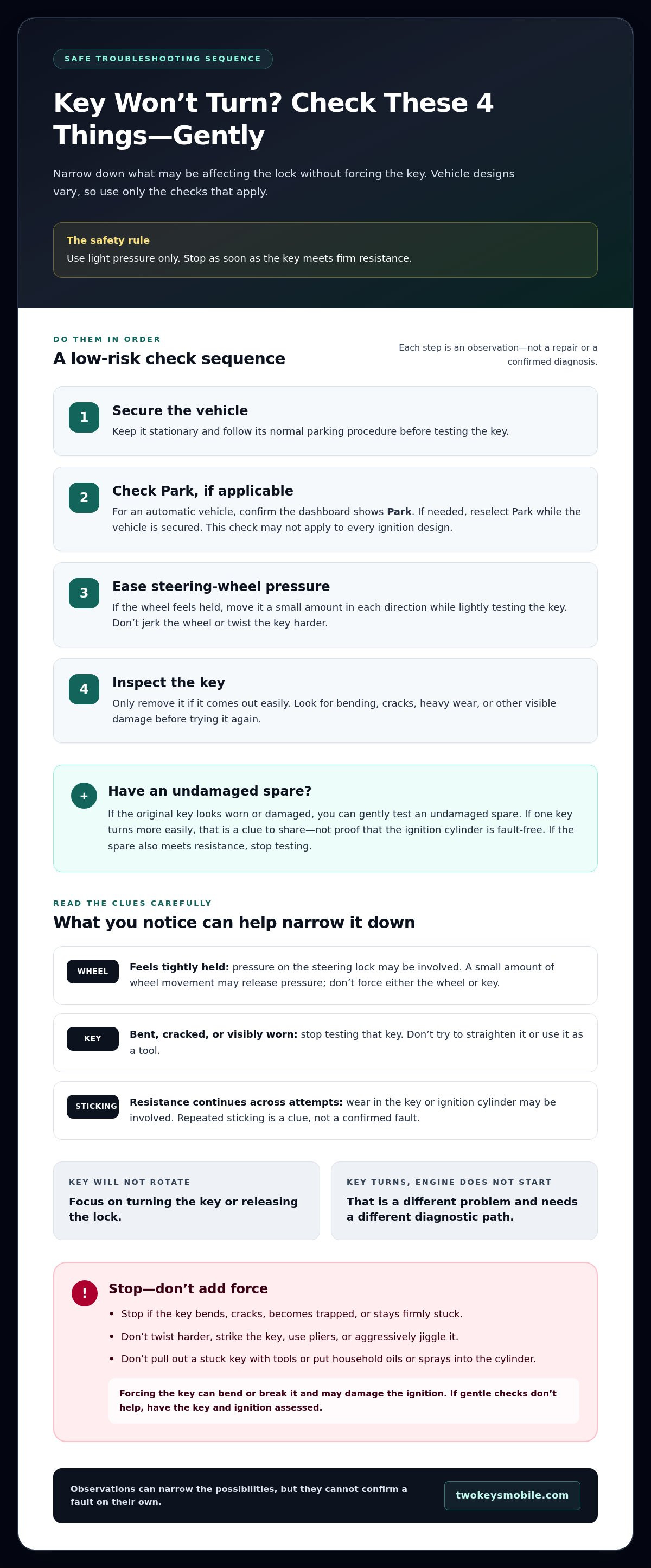
Use this sequence only where it fits your vehicle:
- Secure the vehicle. Keep it stationary and follow the normal parking procedure for your vehicle before testing the key.
- Check Park if the vehicle has an automatic selector. Confirm the dashboard display shows Park. If needed, reselect Park while the vehicle is secured. This check may not apply to every ignition design.
- Relieve steering pressure gently. If the steering wheel feels held, move it a small amount from side to side while lightly testing the key. Don’t jerk the wheel or twist the key harder.
- Inspect the key. Remove it if it comes out easily, then look for bending, cracks, heavy wear, or other damage to the blade before trying it again.
Use only light pressure throughout. If the key bends, cracks, or stays firmly stuck, stop. Continuing can turn a manageable issue into a broken key or ignition damage.
How should you check a worn or damaged key?
Look along the key blade for visible bends, cracks, uneven wear, or other damage. Don’t try to straighten a bent key or use it as a tool. If you have an undamaged spare key, you can test it gently. If it works, the original key may be worn, but that alone doesn’t prove the ignition cylinder is fault-free. Stop if the spare also meets resistance.
Pay attention to what changes between attempts. If one key turns more easily than another, that observation may help a locksmith assess the issue. If both keys stick in the same way, don’t keep testing them repeatedly. Either result is a clue, not a definite diagnosis.
What should you avoid when the key stays stuck?
Don’t twist harder, strike the key, use pliers for leverage, or aggressively jiggle it. These actions can bend or snap the key and may add stress to the ignition cylinder. Avoid putting household oils or sprays into the cylinder, too. They may not address the cause and can complicate the problem.
If the key becomes trapped or starts to bend, stop testing. Don’t pull it out with tools. A mobile locksmith can assess automotive key or ignition issues at the vehicle. If gentle checks haven’t helped, Two Keys Mobile’s automotive key and ignition service is a practical next step.
Key, Steering Lock, or Ignition Cylinder? Compare the Symptoms
A “key won't turn in ignition” complaint can point to several different areas. Note whether the key looks damaged, the steering wheel feels held, or the same resistance happens with another usable key. These observations help describe the problem, but they don’t confirm its cause. A locksmith can inspect the key and ignition in person to determine what’s wrong.
| What you observe | Possible area involved | Cautious next step |
|---|---|---|
| The key blade looks bent, cracked, or heavily worn | The key | Don’t use a visibly damaged key. If you have an undamaged spare, test it gently once. |
| The steering wheel feels held and the key resists turning | Steering lock pressure | Try only gentle wheel movement while lightly testing the key. Stop if either remains stuck. |
| More than one usable key sticks in the same way | Possible ignition-cylinder wear or another lock issue | Stop repeated attempts and arrange professional inspection. |
| The key turns normally, but the engine does not start | A different starting-system symptom | Don’t treat it as a key-that-won’t-turn problem. The cause needs separate diagnosis. |
What may point to a key problem?
Inspect the blade for visible bending, cracks, or heavy wear. A damaged or worn key may not engage the ignition as expected. If an undamaged spare behaves differently, that’s useful information to share with a locksmith, but it doesn’t prove the ignition itself is in good condition. Don’t file, bend, or reshape the key. Altering its profile can make it unusable or complicate diagnosis.
Compare what you can see and feel rather than forcing either key. If the original appears damaged, set it aside. If both keys show similar resistance, that may shift attention toward the lock, but it still isn’t a confirmed diagnosis.
What may point to an ignition problem?
Repeated sticking with more than one usable key is a reason to consider wear in the ignition cylinder or another issue with the lock. A key that remains trapped or repeatedly meets resistance during normal use also deserves professional attention. Don’t keep testing it to see whether the problem gets worse or resolves on its own.
Symptoms suggest possibilities, but they can’t identify a failed cylinder by themselves. A key that turns but doesn’t start the car is different from a key that won’t turn. Keep that distinction clear when describing the issue, and share which keys you tried and what happened. Those details help an in-person inspection focus on the right area.
When a Key Won’t Turn, Know When to Stop and Get Help
Stop troubleshooting if the key is bent, begins to bend, is trapped in the ignition, or still meets firm resistance after gentle checks. A key that won’t turn in ignition can tempt you to try again with more force. Don’t. Twisting harder, striking the key, or using tools for leverage can break it or damage the ignition, turning a small problem into a more involved repair.
Call a professional if gentle steering-wheel movement and other checks suited to your vehicle haven’t changed the symptom. Leave a trapped key where it is rather than trying to pull it out with pliers. A mobile automotive locksmith can assess key and ignition problems at the vehicle. This is locksmith assistance, not roadside mechanical diagnosis or repair.
What should you tell the locksmith?
Share the vehicle’s make, model, and year, then describe exactly what happens: does the key refuse to turn, turn only partway, or remain stuck in the ignition? Mention which gentle checks you tried and whether anything changed. If you safely tested an undamaged spare, say whether it behaved differently. Clear observations help focus the assessment without requiring you to diagnose the fault.
When is mobile locksmith help useful in Central Arkansas?
If the vehicle can’t be started or moved because of a key or ignition issue, on-site automotive locksmith service brings key and ignition assistance to where the vehicle is parked. Two Keys Mobile serves Little Rock and surrounding Central Arkansas communities, including North Little Rock, Conway, and nearby areas. If the issue points to a damaged or unusable key, the professional car key replacement guide explains the replacement topic in more detail.
Keep the issue description focused: explain whether the key is physically stuck, won’t rotate, or turns normally but the vehicle won’t start. The last symptom is different and may call for a separate assessment. Avoid trying to move the vehicle by forcing the ignition or repeatedly testing the key. Two Keys Mobile provides mobile automotive key replacement and ignition repair or replacement, with technicians who each have over 12 years of industry experience.
If the key remains stuck or the ignition still resists after safe checks, see how mobile locksmith service can help.
How Two Keys Mobile Helps With Ignition and Key Problems
If the key still won’t turn after safe checks, guessing at the cause can waste time and risk further damage. Two Keys Mobile provides mobile automotive key replacement and ignition repair or replacement in Little Rock and surrounding Central Arkansas communities, including Maumelle, Sherwood, and Bryant. A technician can assess the reported key and ignition symptoms at the vehicle and determine the appropriate locksmith service.
This is automotive locksmith service, not roadside mechanical diagnosis. If the key is trapped, visibly damaged, or repeatedly resisting, stop testing it and describe what’s happening instead. Clear details help the technician understand whether the concern involves a key that won’t turn, a key that won’t come out, or a different symptom.
What to expect from mobile ignition service
A technician will assess the key and ignition symptoms at the vehicle, including what happens when you insert or gently test the key. Two Keys Mobile handles automotive key replacement and ignition repair or replacement. The technician can explain the appropriate work based on the issue found.
Technicians each have over 12 years of industry experience. Share what you’ve observed, then let the technician assess the key or ignition rather than trying to force the mechanism or take it apart yourself.
What information helps arrange the next step?
Have the vehicle’s make, model, year, and current location ready. Describe whether the key turns at all, is trapped, or shows visible damage. Tell the technician which gentle checks you tried and what changed. If you safely tested an undamaged spare key, mention whether it behaved differently. These details help focus the locksmith service on the actual symptom.
It may help to note whether the steering wheel felt held or whether the vehicle’s gear display showed Park, if those checks apply to your vehicle. Don’t repeat a check that caused resistance. A short, accurate description is more useful than guessing whether a particular part has failed.
For key replacement needs, explore the professional car key replacement guide. It can help you understand the replacement topic while you prepare to explain what happened to your key.
If your key or ignition issue remains unresolved, take the next step with Two Keys Mobile automotive locksmith help. Share the vehicle details and location, and describe the symptom clearly. Don’t force a stuck key while arranging service.
Take the Next Step Without Forcing the Key
A key that won’t turn in ignition can disrupt your plans, but you don’t have to solve the cause by trial and error. Stop before resistance becomes damage. Keep the key as it is, note what you observed, and share those details when arranging help.
If the vehicle remains unusable, Two Keys Mobile provides mobile automotive key replacement and ignition repair or replacement in Little Rock and surrounding communities. A technician can assess the key and ignition symptoms at the vehicle and determine the appropriate locksmith service.
Make the next step simple: have your vehicle details and location ready, then contact Two Keys Mobile for automotive locksmith help. You’ve already taken a careful approach. With the right information and professional support, you can move toward a safe resolution without forcing the ignition.
Frequently Asked Questions
Can a steering wheel lock keep the key from turning?
Yes, pressure on the steering lock can make the key feel stuck in some vehicles. This may happen if the parked wheels are turned against a curb or the steering wheel is held under tension. Try only a small, gentle movement of the wheel while testing the key lightly. If it remains resistant, stop. Don’t force the key or rock the wheel hard to release the lock.
Can a dead car battery stop a key from turning in the ignition?
Usually, a dead battery affects the vehicle’s electrical systems and starting ability, not the movement of a traditional metal key in a mechanical ignition cylinder. Some vehicles use electronic locking or starting systems, so behavior can vary by design. If the key physically won’t rotate, don’t assume the battery is the cause. Note whether dashboard lights work, and treat a no-start with a freely turning key as a separate symptom.
Should I use lubricant if my key will not turn?
Don’t put household oil or an unapproved spray into the ignition. It may leave residue or fail to address the reason the key is binding. Check your vehicle’s owner’s manual for manufacturer guidance before using any product in the lock. If the key still resists, stop testing it instead of adding more lubricant. A locksmith can inspect the key and ignition and help determine the appropriate next step.
Can a locksmith make a new car key if the old one will not turn?
A locksmith can assess whether the key may need replacement, but a new key won’t necessarily fix a worn or damaged ignition cylinder. Two Keys Mobile provides automotive key replacement in Little Rock, North Little Rock, Maumelle, Conway, Sherwood, Jacksonville, Cabot, Beebe, Bryant, Benton, East End, Mabelvale, and Mayflower. Describe the symptom and vehicle details so the key and ignition issue can be assessed appropriately.
Is it safe to drive if the key sometimes sticks in the ignition?
If the key binds while you’re trying to start or switch off the vehicle, don’t set off until the issue has been assessed. A sticking key may become trapped or harder to turn, leaving you unable to operate the ignition as expected. If it begins sticking while you’re already moving, keep your attention on driving and pull over somewhere safe before addressing it. Don’t try to remove or adjust the key while driving.
Why does my spare key turn when the original key will not?
The original may be worn, bent, or damaged in a way that affects how it fits the ignition. A spare that turns more smoothly is a useful clue, but it doesn’t rule out wear in the ignition cylinder. Stop using a visibly damaged key, and don’t reshape it yourself. Tell the locksmith which key worked and how the original behaved. That comparison can help guide an in-person assessment.
Can cold weather affect a car key or ignition?
Cold weather can make existing stiffness more noticeable, but it doesn’t identify the cause by itself. If the key or lock feels stiff, don’t heat the key with an open flame or force it into the ignition. Check your owner’s manual for vehicle-specific guidance, especially if the car uses an electronic key system. If resistance continues after conditions change, have the key and ignition assessed rather than relying on repeated attempts.


