
Losing your only car key doesn’t mean you need the original to make a replacement. If you’re wondering how to get a replacement car key without the original, the process starts with your vehicle’s identity and key system, not a key to copy. It can feel uncertain if you don’t know whether your car uses a basic metal key, a transponder, or a smart key. You may also be unsure what proof of ownership to have ready or how to get help where the vehicle is parked.
Before arranging service, gather your VIN, make, model, and year, along with photo ID and a document connecting you to the vehicle, such as its registration, title, or insurance card. This guide explains how replacement keys are made, why some need programming, and what information to prepare. It also covers mobile key replacement in Little Rock and nearby communities, including North Little Rock, Maumelle, Conway, Sherwood, and Bryant. Two Keys Mobile provides on-site automotive key replacement, with technicians who each have more than 12 years of industry experience.
Key Takeaways
- Learn how to get a replacement car key without the original by starting with your vehicle’s details and key system, rather than a spare to copy.
- Understand the general steps involved in identifying the vehicle, producing a key, and testing it.
- Compare mobile locksmith and dealership options based on your vehicle and circumstances.
- Prepare the vehicle’s year, make, model, location, and available ownership documents before arranging service.
- Find out how mobile key replacement can help drivers in Little Rock, North Little Rock, Maumelle, Conway, Sherwood, Jacksonville, and Bryant.
Can You Get a Replacement Car Key Without the Original?
Yes. An original key isn’t always needed to make a replacement. The vehicle’s year, make, model, and key system help determine how a new key can be produced and whether it needs electronic programming. Losing the key doesn’t automatically leave you without a way to identify the right replacement.
Replacement without an original means creating a key for a specific vehicle using its identifying information and key system, rather than copying a key you still have. The new key still needs to match the vehicle and work as intended. The process depends on the key type, so two cars with similar-looking keys may need different procedures.
It helps to distinguish two tasks: cutting shapes a physical blade so it operates the vehicle’s lock, while programming pairs an electronic key or chip with the vehicle’s security system. A basic metal key may only need cutting. An electronic key may need cutting, programming, or both. For a general overview of how key designs and security features have changed, see Car Key Types and Technology.
What information identifies the right replacement key?
Start with the vehicle’s year, make, and model. The Vehicle Identification Number, or VIN, can help identify the specific vehicle and narrow down which key system applies. A VIN isn’t a working key and can’t unlock or start the car by itself. A technician uses it alongside the vehicle details to identify the appropriate replacement and process.
Share the details accurately, including the full model name if you know it. A model’s key system can vary by year or configuration, so appearance alone may not tell the whole story. The vehicle details help identify which system applies.
Why key type changes the replacement process
A basic mechanical key has a shaped metal blade that operates a lock. A transponder key includes an electronic chip that communicates with the vehicle. A smart key, often used with push-button start, relies on electronic communication rather than only a blade inserted into an ignition. These types can look similar, but their replacement needs differ.
For electronic keys, cutting the blade doesn’t necessarily make the key functional. The replacement may also need programming to the vehicle’s security system. The exact tools and steps depend on the vehicle and key system, so there isn’t one universal method. If you’re researching how to get a replacement car key without the original, identifying the key type is a useful first step.
- Mechanical key: The main task is shaping a blade that fits the vehicle’s lock.
- Transponder key: The replacement may need a cut blade and electronic programming.
- Smart key: The replacement process centers on the vehicle’s electronic key system, with steps varying by model.
Knowing which category your key falls into helps set expectations before replacement begins. If you’re unsure, share the vehicle details and whatever you remember about the missing key.
How Locksmiths Make a Car Key When No Original Exists
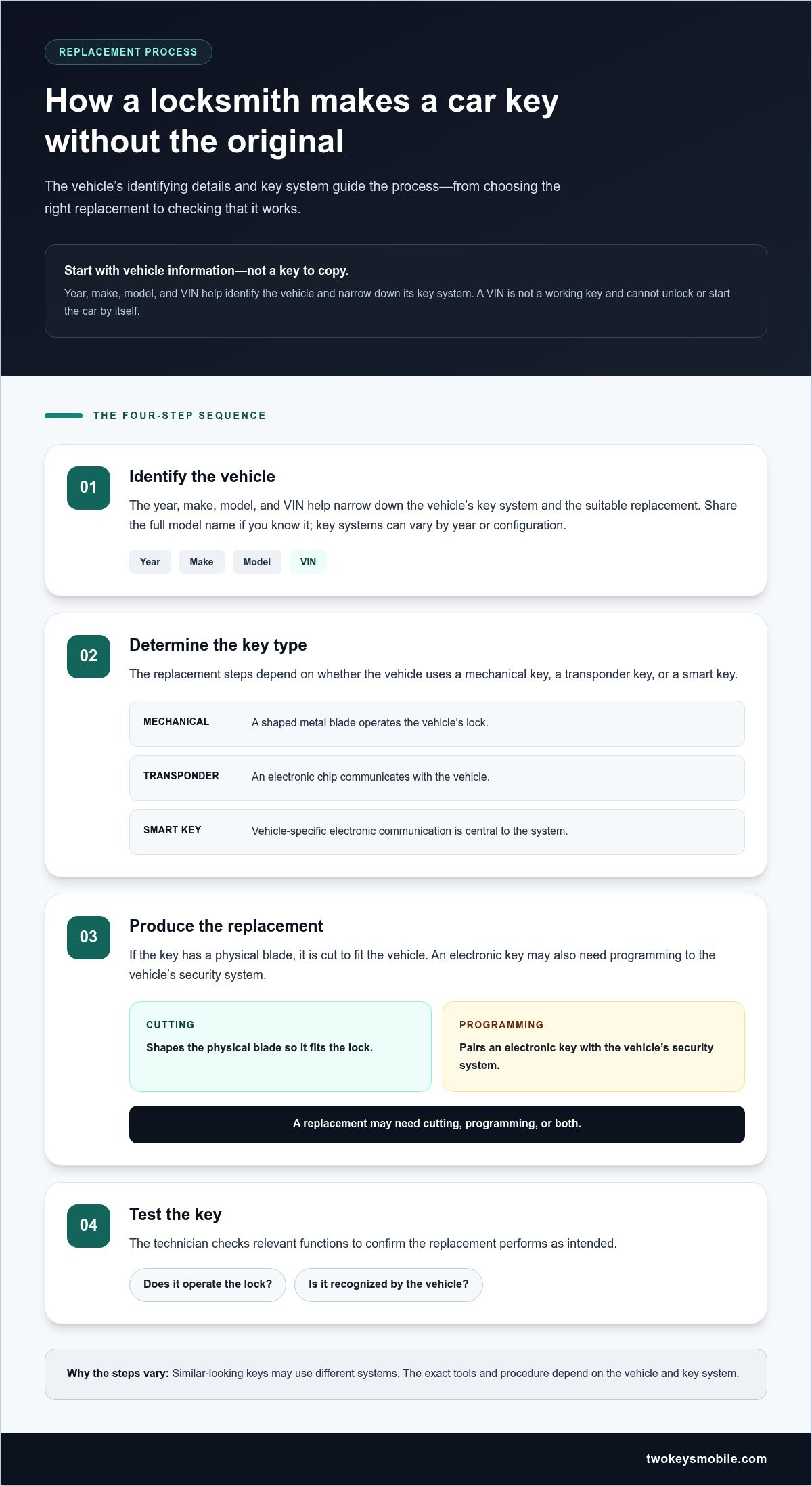
A missing key doesn’t leave a locksmith with nothing to work from. Vehicle-specific information and the key system help determine what needs to be made and how it should work. The exact method varies by vehicle, but the general sequence is to identify the vehicle, determine the key type, produce a replacement, and test it.
- Identify the vehicle. The year, make, model, and VIN help narrow down the key system and suitable replacement.
- Determine the key type. The technician identifies whether the vehicle uses a mechanical key, transponder key, or smart key.
- Produce the replacement. If there’s a blade, it’s cut to fit the vehicle. An electronic key may also need programming.
- Test the key. The technician checks relevant functions, such as operating the lock or being recognized by the vehicle.
Key cutting shapes the physical blade to fit the lock; key programming pairs an electronic key with the vehicle’s security system. These are separate tasks, and a replacement may need one or both. For an overview of how key types affect replacement, see Allstate’s guide to Replacing a Lost Car Key: Dealership vs. Locksmith.
How a mechanical key is cut without a copy
A locksmith doesn’t need the lost key as a template. Vehicle and key information can help the technician determine the correct cut pattern for a replacement blade. The blade is shaped so its grooves and edges correspond to the vehicle’s lock. The specific approach depends on the vehicle and available key information, so there isn’t one cutting method that applies to every car.
This differs from simply copying a spare. The goal is to make a new key that matches the vehicle, then check that the cut blade operates the relevant lock. If the vehicle also uses an electronic key, a correctly cut blade alone may not be enough to start it.
How transponder and smart keys are prepared
A transponder key contains a chip that communicates with the vehicle’s immobilizer, a security feature that helps prevent the engine from starting with an unrecognized key. A smart key also relies on vehicle-specific electronic communication. In either case, programming is separate from cutting any physical blade. The replacement must be matched to the vehicle’s security system.
The required steps depend on the vehicle’s key system. A replacement may need cutting, programming, or both, and the equipment and procedure can differ by model. Testing helps establish whether the new key performs its intended functions, including electronic recognition where applicable.
For vehicles in the Little Rock area, Two Keys Mobile provides mobile automotive key replacement at the vehicle’s location. The technicians each have more than 12 years of industry experience.
Locksmith or Dealership: Which Route Makes Sense Without a Key?
An automotive locksmith and a dealership may both be options when every key is missing, but the practical steps can differ. Your vehicle’s key system, where the car is parked, and whether it can be moved all matter. The right route depends on your vehicle and situation.
A mobile locksmith comes to the vehicle and can provide on-site key replacement. This is useful if the car is parked at home, at work, or somewhere it can’t readily be driven. On-site service can also avoid arranging transport to a dealership. The procedure still depends on the vehicle and its key system, so share those details when arranging service.
When mobile locksmith service may be convenient
Start with the vehicle’s location. If the car is immobile because there’s no working key, mobile service brings the replacement work to the vehicle. This can simplify logistics compared with getting the car to a fixed location. A locksmith can assess the vehicle’s key needs and carry out on-site replacement.
Consider what would make the process easier. If moving the car is difficult, a mobile option can reduce the need to coordinate transportation. If the vehicle is accessible, it can stay where it is while the key replacement is handled.
When a dealership route may be appropriate
A dealership may suit a vehicle with key requirements tied to its make, model, or security system, or an owner who prefers to use the vehicle’s dealership service channel. Procedures vary. Depending on the vehicle, the dealership may need the car at its location, so consider how it would get there if it can’t be driven.
Don’t assume every dealership replacement requires towing, or that every vehicle follows the same process. The vehicle’s key system determines what’s practical. If transport is needed, factor in the extra coordination and service location. If the vehicle can be moved easily, taking it to a dealership may be straightforward. If not, mobile service can be more convenient.
Use these points to weigh the routes:
- Vehicle requirements: The make, model, and key system affect which process is suitable.
- Location: Consider whether the car is accessible and where the work can take place.
- Mobility: If the vehicle can’t be driven, account for transport if a dealership visit is needed.
- Practical fit: Compare the steps with your circumstances rather than assuming one route is always better.
Choosing how to get a replacement car key without the original means considering both the vehicle and its location. Weigh the key system, whether the car can be moved, and the practical work involved before deciding.
What to Prepare Before Getting a Replacement Car Key
Gathering a few details in advance helps the technician understand the vehicle and prepare for replacement. You don’t need to identify every technical feature yourself. Share what you know and be clear about anything you’re unsure of.
Vehicle details and location to have ready
Write down the vehicle’s year, make, and model. If you can access it, have the VIN ready too. Tell the technician where the vehicle is parked and whether it’s accessible, such as in a driveway, parking garage, or roadside space. Mention any access details that could affect reaching the car. A clear description helps the technician prepare for the vehicle and location.
- Vehicle: Year, make, model, and VIN if readily available.
- Location: The address or a clear description of where the car is parked.
- Access: Whether the car is accessible and anything that may limit access.
- Key details: What you remember, such as a metal blade, remote buttons, transponder, or smart-key features.
Ownership and key-system details to share
Have a government-issued photo ID and available ownership documents ready for verification. Registration, a title, or an insurance card can help connect you to the vehicle. This helps protect the car from unauthorized key requests. If the name on a document differs from yours, explain the relationship or situation so the details are clear.
Mention any ignition issue or visible damage as well. Key replacement and ignition problems can involve different work, so describe the situation accurately. For example, say whether the ignition has been difficult to turn, is damaged, or had problems before the key went missing.
Use this checklist before arranging service:
- Vehicle information: Year, make, model, and VIN if available.
- Current location: Where the vehicle is, plus any access considerations.
- Ownership verification: Photo ID and available registration, title, or insurance documents.
- Key type clues: Whether the missing key had a blade, remote, transponder, or smart-key features.
- Vehicle condition: Any ignition trouble or damage that may be relevant.
You don’t need to identify the key type yourself. Describe its appearance and functions as best you can. For additional preparation guidance, see the professional car key replacement in Little Rock guide. Having these details ready makes the first conversation clearer and helps establish the next step. For mobile automotive key replacement in Little Rock and surrounding communities, contact Two Keys Mobile to arrange key replacement.
Get Mobile Replacement Car Key Help in Little Rock
Losing your only car key can leave you unsure how to move forward, especially if the vehicle is parked somewhere it can’t easily be driven. Two Keys Mobile provides mobile automotive key replacement in Little Rock and surrounding Arkansas communities, bringing service to the vehicle’s location. This gives drivers a practical option without starting with a trip to a shop.
What to expect from mobile automotive key replacement
The technician works at the vehicle’s location, using the vehicle details to identify the car and assess its key system before beginning replacement work. The process depends on the vehicle and key type. Share the vehicle’s location, year, make, and model, along with any ownership documents you have ready.
Preparing these details makes the first conversation clearer. If you’re unsure whether the missing key was a transponder or smart key, describe what it looked like and how you used it. Mention any ignition trouble or damage, too. You don’t need to diagnose the key system yourself. The technician can assess the vehicle and explain the next steps.
Arrange help across Little Rock and nearby communities
Mobile service is available in Little Rock and surrounding areas, including North Little Rock, Maumelle, Conway, Sherwood, Jacksonville, Cabot, Beebe, Bryant, Benton, East End, Mabelvale, and Mayflower. Drivers in these communities can have the vehicle assessed where it’s parked, rather than assuming it must first be taken to a service location.
Two Keys Mobile technicians each have more than 12 years of industry experience. When there’s no original key to copy, the technician considers the vehicle details, key system, and circumstances at the vehicle’s location, then explains the replacement process for that situation.
If you’re working out how to get a replacement car key without the original, start with the information you have and where the vehicle is parked. Keep your ID and available ownership documents nearby. Then request mobile car key replacement help from Two Keys Mobile. A clear description of the vehicle and location is a practical first step.
Take the Next Step Toward Getting Back on the Road
Not having a spare key doesn’t leave you without a path forward. Share what you know about the vehicle and where it’s parked, then have a technician assess the key system and explain the replacement process. You don’t need to work out the technical details yourself. Clear information helps get things started.
If you’re still asking how to get a replacement car key without the original, focus on arranging an assessment rather than searching for a key to copy. Have your vehicle details and ownership documents nearby, and describe any ignition concerns. That gives you a clear starting point for what happens next.
For mobile automotive key replacement in Little Rock and surrounding communities, request mobile car key replacement help from Two Keys Mobile.
Frequently Asked Questions
Can a locksmith make a car key without the original?
Yes. An automotive locksmith can create a replacement without the missing key to copy. The technician uses information about the vehicle and its key system to determine the appropriate approach. The work depends on the car, so share its year, make, model, and anything you remember about the key. That gives the technician a useful starting point.
Can a car key be made from the VIN alone?
No. A VIN helps identify the vehicle, but it isn’t a key and can’t unlock or start the car. It’s one piece of information used alongside the vehicle’s year, make, and model. You’ll also need to be prepared to verify that you’re authorized to request a key. Keep your photo ID and available ownership documents handy.
Do I need to tow my car to get a replacement key?
Not always. Mobile automotive key service can work at the vehicle’s location, avoiding the need to arrange a tow. The process depends on the vehicle and its key system. If the vehicle requires a dealership visit or another process, transportation may be necessary. Consider where the car is parked and whether it can be moved when choosing your next step.
How long does it take to replace a car key without the original?
There isn’t one reliable timeframe for every replacement. The vehicle’s key type, the work involved, and the circumstances at the vehicle can affect how long the process takes. A basic blade key and an electronic key may require different steps. Share the vehicle details and describe the missing key when arranging service. That helps the technician understand the job before work begins, without relying on a generic time estimate.
Will a replacement transponder key start my car immediately?
A transponder replacement needs to be recognized by the vehicle’s immobilizer before it can start the car. If the key is correctly matched and programmed for that vehicle, it should perform that function. A cut blade alone may not be enough. After replacement, have the key tested in the vehicle rather than assuming it will start the car based on its appearance.
What should I do if I lose my only car key in Little Rock?
Note where the vehicle is parked and gather its year, make, model, and VIN if available. Keep your photo ID and registration, title, or insurance documents ready for ownership verification. Two Keys Mobile provides mobile automotive key replacement in Little Rock and surrounding communities, including North Little Rock, Maumelle, Conway, Sherwood, Jacksonville, Cabot, Beebe, Bryant, Benton, East End, Mabelvale, and Mayflower. Share the vehicle’s location when arranging help.
Can a replacement key also unlock the car?
It may, depending on the replacement type and how it’s made for the vehicle. A cut blade can operate compatible locks, while a remote or smart key uses electronic functions. Don’t assume a key will both unlock and start the car just because one function works. Describe which functions you need, such as door access, trunk access, or starting, so they can be considered during replacement.


