
A car that won’t start may have a stuck key, a worn ignition cylinder, or a faulty switch. The ignition switch controls electrical systems needed to start and run the vehicle, and ignition repair can address problems with the switch or related parts. If the engine shuts off while driving, treat it as urgent and get to a safe place.
A key that won’t turn or is difficult to remove can be stressful, especially when you need your car. This guide explains what the switch does, how broken-key extraction works, and what can cause common ignition problems, so you can recognize when ignition repair may be needed.
You’ll learn what to expect during inspection and repair, which symptoms need prompt attention, and when emergency service may help. Understanding the ignition repair process can clarify your next step, whether the problem is a stuck key, a silent start, or an engine that cuts out.
Key Takeaways
- Learn how the ignition barrel, lock cylinder, and electrical switch work together, and why identifying the faulty part matters.
- If a key snaps or sticks, avoid forcing it; careful extraction can help prevent further damage to the cylinder.
- Use symptoms such as a rough-turning key, failed start, or engine cut-out to recognize when the ignition system needs attention.
- Understand how inspection helps distinguish ignition faults from issues with related components before repair begins.
- When a damaged key or ignition problem leaves you unable to use your vehicle, automotive key replacement may help with the next step.
What Is An Ignition Switch?
The ignition switch controls electrical power used to start and run a vehicle. The ignition barrel and lock cylinder hold and turn the key, while the switch activates related electrical circuits. Ignition repair may involve any of these parts, so identifying the fault is essential.
Ignition Barrel, Lock Cylinder, and Switch Replacement
These parts work together, but a fault in one doesn’t always mean all three need replacing. A worn lock cylinder may make the key stiff or stop it from turning, while a switch fault can interrupt electrical starting. A technician can inspect key movement and related wiring to identify the part that needs attention. The vehicle’s design affects access and replacement.
Ignition Cylinder Rebuilding or Replacement
Rebuilding addresses worn internal cylinder parts, while replacement installs another cylinder. When possible, a replacement cylinder can be rekeyed to work with the vehicle’s existing key. That may preserve one-key access, depending on the cylinder’s design and condition. If the key has a transponder chip, replacement may also require a new, programmed key as part of the ignition repair.
Can a locksmith repair an ignition, or should I use an auto mechanic? A locksmith can work on ignition locks, cylinders, and keys. A mechanic may be a better fit when inspection points to a broader electrical or engine-system fault rather than a lock or key problem.
How long does ignition repair or replacement take? Switch repair may take as little as 20 minutes or less than an hour. Replacement time depends on vehicle access, the component involved, and whether a transponder key needs programming.
Does car insurance or an extended warranty cover ignition repair? Coverage depends on the policy or warranty terms and the cause of the failure. Review covered components, exclusions, and claim requirements before authorizing work.
How do I find a reputable ignition repair service near me? Look for an automotive locksmith or repair professional who works on ignition cylinders and switches. Share the vehicle’s make, model, and symptoms to help identify the likely issue.
Motorcycle ignition systems also use a key-operated lock and electrical switch, though their parts and access differ from cars. Describe whether the key won’t turn, the motorcycle won’t start, or power cuts out. Those details help narrow down the problem.
A key fob’s remote buttons and transponder function are separate considerations. After cylinder replacement, test whether the key starts the vehicle and the remote functions still work. Chipped keys may need programming to work with the replacement setup.
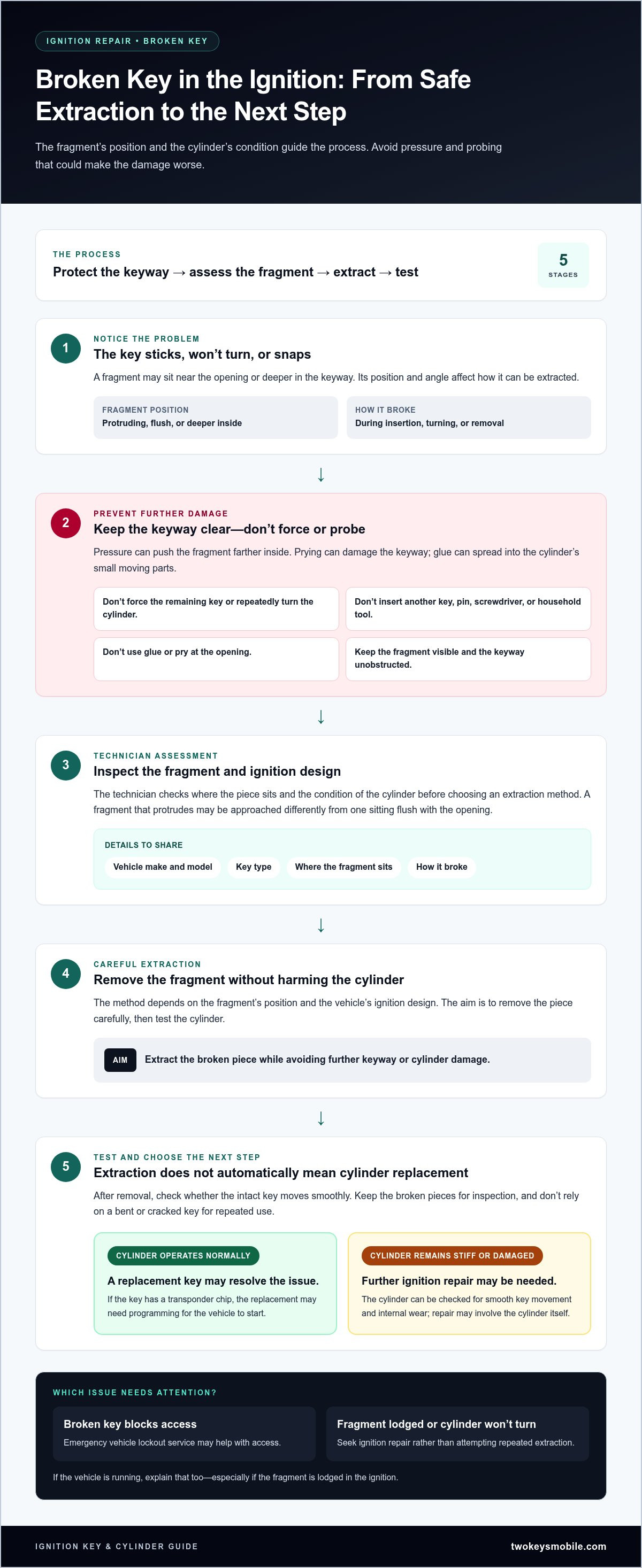
Broken key extraction from the ignition cylinder
A key that sticks, won’t turn, or snaps inside the ignition cylinder can stop a vehicle from starting. The fragment may sit near the opening or deeper in the keyway, and its position and angle affect extraction. Avoid forcing the remaining key or repeatedly turning the cylinder, since pressure can push the fragment farther inside.
Keep the keyway clear. Don’t insert another key, pin, screwdriver, or household tool to probe for the broken piece. Glue can spread inside the cylinder and interfere with its small moving parts. Prying at the opening may damage the keyway and turn a simple extraction into a larger ignition repair.
A technician examines the fragment and cylinder before choosing an extraction method. A piece that protrudes can be approached differently from one sitting flush with the opening. The vehicle’s ignition design matters, too. Careful extraction aims to remove the fragment without harming the cylinder, which can then be tested.
- Keep the fragment visible. Don’t press it deeper or cover the keyway with tools.
- Recall how it broke. Note whether it snapped during insertion, turning, or removal.
- Share vehicle details. The make, model, and key type help identify the ignition setup.
After the piece is removed, check whether the intact key still moves smoothly. A bent or cracked key can break again, so don’t rely on it for repeated use. If the key has a transponder chip, a replacement may need programming for the vehicle to start. Keep any broken pieces for inspection.
Extraction doesn’t automatically mean the ignition cylinder needs replacing. The cylinder can be checked for smooth key movement and internal wear. If it operates normally, replacing the key may resolve the issue. If it remains stiff or damaged, further ignition repair may involve the cylinder itself.
If a broken key has left you unable to access the vehicle, emergency vehicle lockout service may help with access. For a fragment lodged in the ignition or a cylinder that won’t turn, seek ignition repair instead of trying repeated extraction. Explain where the fragment sits and whether the vehicle is running. That information helps clarify the problem and the next step.
Ignition switch maintenance and repair
An ignition switch fault can interrupt starting or shut down a running vehicle. An inspection should cover the switch, ignition lock, system wiring, and related components.
Can I drive a car with a faulty ignition switch? A faulty switch can cause the engine to shut off while driving. According to the U.S. Government Publishing Office, a defective ignition switch can turn off when the car goes over a bump, so don’t continue driving if power cuts out.
Ignition Switch Installation
Installation starts with identifying the correct switch and how it connects to the vehicle’s ignition system. A technician accesses the switch, removes the faulty part, and installs its replacement while checking wiring and connections. The vehicle’s design determines access and setup. After installation, test the key positions and confirm the system starts smoothly.
Ignition Switch Damage and Repair
Damage may affect the switch, its connections, or nearby wiring. Symptoms alone can’t identify the failed part, so inspect those components before choosing repair or replacement. For example, if the key turns but the vehicle won’t start, check the switch and related circuits rather than assuming the lock cylinder is at fault.
During ignition repair, a technician assesses the lock, switch, wiring, and other ignition-system components. This helps distinguish a switch problem from a cylinder issue or wiring fault. Repair may address the affected component; replacement is appropriate when the switch is damaged beyond repair. After the work, test for smooth, reliable starting.
Switch trouble needs prompt attention if the engine stalls, electrical power drops, or starting becomes inconsistent. A shutdown over a bump is especially concerning because vibration can reveal an intermittent fault. Stop driving if the engine cuts out, and arrange an inspection rather than repeatedly cycling the key to restart it.
Pay attention to changes in key movement and starting behavior. Don’t force a stiff key or repeatedly twist it when the switch doesn’t respond. Note when the fault occurs: during starting, after the engine runs, or when the vehicle goes over a bump. These details help focus the inspection.
- Describe the symptom. Record whether the key turns, electrical power appears, and the engine starts.
- Report interruptions. Mention any shutdown or power loss while driving, including what happened immediately beforehand.
- Test after repair. Confirm the key operates the switch and the vehicle starts smoothly.
Switch repair may take as little as 20 minutes or less than an hour. The time depends on access, the fault, and whether installation or additional wiring work is needed. A clear description of the symptom helps focus the inspection and repair.
Common ignition symptoms and causes
A rough key turn, a silent start, or an engine misfire can point to different faults. Record exactly what happens before seeking ignition repair. Symptoms help distinguish a lock or switch problem from an issue involving spark plugs, ignition coils, or another starting component.
A stiff, rough, or unusually loose ignition suggests trouble around the keyway or ignition cylinder. Notice whether the key catches during insertion, turning, or removal. A key that turns but doesn’t start the vehicle points to a different problem than one that won’t turn at all. Don’t force it, since repeated pressure can complicate diagnosis.
A working key with no start can indicate an ignition fault, but doesn’t identify the failed part on its own. The ignition system includes components that deliver the electrical spark needed for combustion. A technician can assess the switch, wiring, and related parts, then compare the findings with your description.
Engine sputtering, shaking, or misfiring can occur when an ignition coil fails. Bad spark plugs can also make starting difficult, cause unusual vibrations under the bonnet, and increase fuel consumption. These symptoms can resemble other engine problems, so describe when they happen, such as during startup or while driving.
A steering wheel that remains locked and won’t release may accompany ignition trouble. The lock can put pressure on the key, making it difficult to turn. Don’t yank the wheel or twist the key hard. Note whether the wheel moves slightly and whether the key turns, then share those details during inspection.
- Key feels stiff or loose: report where the movement catches or feels abnormal.
- Engine won’t start: say whether the key turns and whether electrical power appears.
- Engine shakes or misfires: describe the driving conditions and any unusual vibrations.
- Steering stays locked: mention whether the key moves and the wheel releases.
Use these observations to guide the next step, not replace a diagnosis. A technician checks the ignition switch, cylinder, wiring, and related components to locate the cause. If the engine shuts off while driving, stop using the vehicle and arrange prompt assessment. Reliable starting depends on identifying the failed part before replacing components.
Emergency ignition repair
An ignition failure becomes urgent when a key won’t turn, a broken piece blocks the cylinder, or the engine shuts off. Focus first on safety, then share the exact symptom and vehicle details to help assess the problem efficiently.
If the engine cuts out while driving, move out of traffic and stop in a safe location. Don’t continue driving a vehicle that loses power unexpectedly. A defective ignition switch can turn off when the car goes over a bump, according to the U.S. Government Publishing Office. Report when the shutdown happened and whether the vehicle restarted.
If you’re stranded with a key stuck in the ignition, don’t force it or push tools into the keyway. That can damage the cylinder and complicate extraction. If the key snapped, keep the remaining piece and tell the technician whether it broke while turning, inserting, or removing it. If the key turns but the engine won’t start, describe whether dashboard lights come on.
A mobile locksmith can assess ignition problems where the vehicle is parked. The inspection may cover the key, cylinder, switch, wiring, and related parts. The technician uses the symptoms and vehicle information to determine whether ignition repair or replacement is appropriate. Broken-key extraction differs from switch repair, so explain exactly what happened when requesting service.
Share the vehicle’s make, model, and key type when arranging help. Mention whether it uses a traditional key or a transponder key, and whether you have a spare. If the vehicle is blocking a driveway or parked in a restricted spot, describe the location clearly. These details help prepare for access and possible key or programming needs.
Use this quick sequence while waiting:
- Move away from traffic if the engine has stalled.
- Keep the key and any broken fragments accessible.
- Record the vehicle details and the symptoms you observed.
- Avoid repeated attempts to turn a stuck key or restart a vehicle that stalls.
A skilled technician can address a failed ignition cylinder or switch, while a broader engine or electrical fault may need mechanical diagnosis. The key distinction is whether the problem centers on the lock, key, or ignition components. Describe any misfiring, shaking, or power loss, as these symptoms can point beyond the key mechanism.
If you’re stranded because a key or ignition fault prevents vehicle use, request mobile ignition repair. Explain whether the key is stuck, broken, or turning without starting the vehicle, and provide its location and identifying details.
Two Keys Mobile: Automotive Key Replacement
Two Keys Mobile provides Automotive Key Replacement when a damaged or missing key leaves you unable to use your vehicle. If the key broke during ignition trouble, replacement may be the next step after the fragment is removed and the ignition is assessed. Share the vehicle’s make, model, and key details to clarify the issue.
If you’re locked out and can’t reach the vehicle’s key, Emergency Vehicle Lockout Service can help restore access. This service addresses key and vehicle access problems, not engine or roadside mechanical faults. Describe what happened and whether the key is stuck, broken, or missing.
For help with a vehicle key or lockout, contact Two Keys Mobile or visit twokeysmobile.com.
Choose the Right Next Step for Your Vehicle
A key or ignition fault can disrupt your plans, but a clear description helps move the repair forward. Note what the key does, whether the vehicle starts, and whether you’re locked out. Then choose help that fits the problem: ignition repair for a faulty ignition, key replacement for a damaged or missing key, or vehicle lockout service when you can’t get inside.
Two Keys Mobile offers Automotive Key Replacement and Emergency Vehicle Lockout Service for vehicle access and key concerns. For a separate home-security need, the company also provides Residential Rekeying. Describe the issue clearly to help direct your request to the relevant service.
Contact Two Keys Mobile about your vehicle key or ignition issue. Take the next step with a clear account of what happened, and get back to making your plans with confidence.
Frequently Asked Questions
How much does it cost to fix an ignition?
The price depends on the fault and is provided after a quote request. Cost factors include whether the work involves a key, cylinder, switch, wiring, or programming, as well as vehicle access and required replacement parts. For example, extracting a fragment from a working cylinder differs from replacing a damaged switch. Share the vehicle details and symptoms to clarify what the quote covers.
Can I replace my own ignition?
You can attempt replacement if you have relevant mechanical experience, but ignition replacement involves vehicle-specific parts and connections. The wrong fit or an overlooked electrical connection can leave the vehicle unable to start. First identify whether the fault is in the lock cylinder, switch, or related wiring. If the key has a transponder chip, include key compatibility and programming in the repair plan.
Does a new ignition have to be programmed?
Not every replacement requires programming. If your vehicle uses a transponder key with a chip, replacing the ignition may require a new key and programming for the vehicle to start. Remote fob buttons are a separate function, so test both starting and remote operation after the work. Tell the technician whether you use a traditional key, a chip key, or a fob with push-button starting.
Ignition Not Working?
If the ignition won’t turn or the vehicle won’t start, note what happens before trying again. Does the key move? Do dashboard lights appear? Does the engine crank? These observations help distinguish a lock or switch fault from another starting issue. Don’t force a stuck key. For drivers around Little Rock, contact Two Keys Mobile for ignition service or vehicle key assistance.
What are signs of ignition problems?
Common clues include a key that feels rough, stiff, or unusually loose; a vehicle that won’t start with a working key; or a steering wheel that stays locked. Note when each symptom occurs, such as during key insertion or after turning it. If a spare key behaves differently, that can help determine whether the key itself or the vehicle’s ignition components need attention.
What does ignition repair include?
Ignition repair can include inspecting the lock cylinder, switch, wiring, and related components to locate the fault. Work may involve repairing a component, realigning or cleaning the ignition, or replacing a damaged part. The technician then tests the system for smooth starting. Mention intermittent symptoms, such as a key that works only after several attempts, to help focus the inspection.
What are common signs of ignition system problems?
Starting trouble can also come from ignition-system parts beyond the key and switch. Bad spark plugs may make starting difficult, cause unusual engine vibrations, or increase fuel consumption. A failing ignition coil can cause sputtering, shaking, or misfires. Note whether symptoms occur while starting, idling, or driving. This helps a technician assess whether the issue involves the ignition system or another vehicle fault.
How much does ignition repair cost in the United States?
There isn’t one price for every vehicle or fault. Cost depends on the part involved, the work required, vehicle access, and whether replacement keys or programming are needed. Cylinder repair, switch replacement, and wiring issues involve different tasks. For service in Little Rock, North Little Rock, Maumelle, Conway, Sherwood, Jacksonville, Cabot, Beebe, Bryant, Benton, East End, Mabelvale, or Mayflower, request a quote with your vehicle details and symptoms.


