
Replacing the fob yourself may be possible; getting a new smart key to start the car usually takes vehicle-specific programming. For push to start key replacement, the key’s code must match the unique code programmed into the vehicle’s body control module for the powertrain to operate, according to the National Highway Traffic Safety Administration.
A dead fob battery is different from a lost or damaged key. You may be able to replace the battery yourself, but a new or unpaired smart key can require specialized programming. A fob that looks right may still be incompatible with your vehicle.
This guide explains what you can handle at home, how to identify a compatible replacement, and what affects the cost and timing. It also compares dealership service with mobile locksmith service, so you can choose a practical next step.
Key Takeaways
- Separate a depleted fob battery from a lost or unpaired smart key before deciding what kind of replacement you need.
- Match a replacement fob to your vehicle’s make, model, and key system; appearance alone doesn’t establish compatibility.
- Compare dealer and mobile locksmith service by considering the full process, including transport, programming, and waiting time.
- Plan for different on-site timing depending on whether you have a working spare or need a full immobilizer reprogram.
- See how having a spare can affect replacement costs, and what vehicle details and ownership documents to prepare.
Identifying compatible smart keys by vehicle
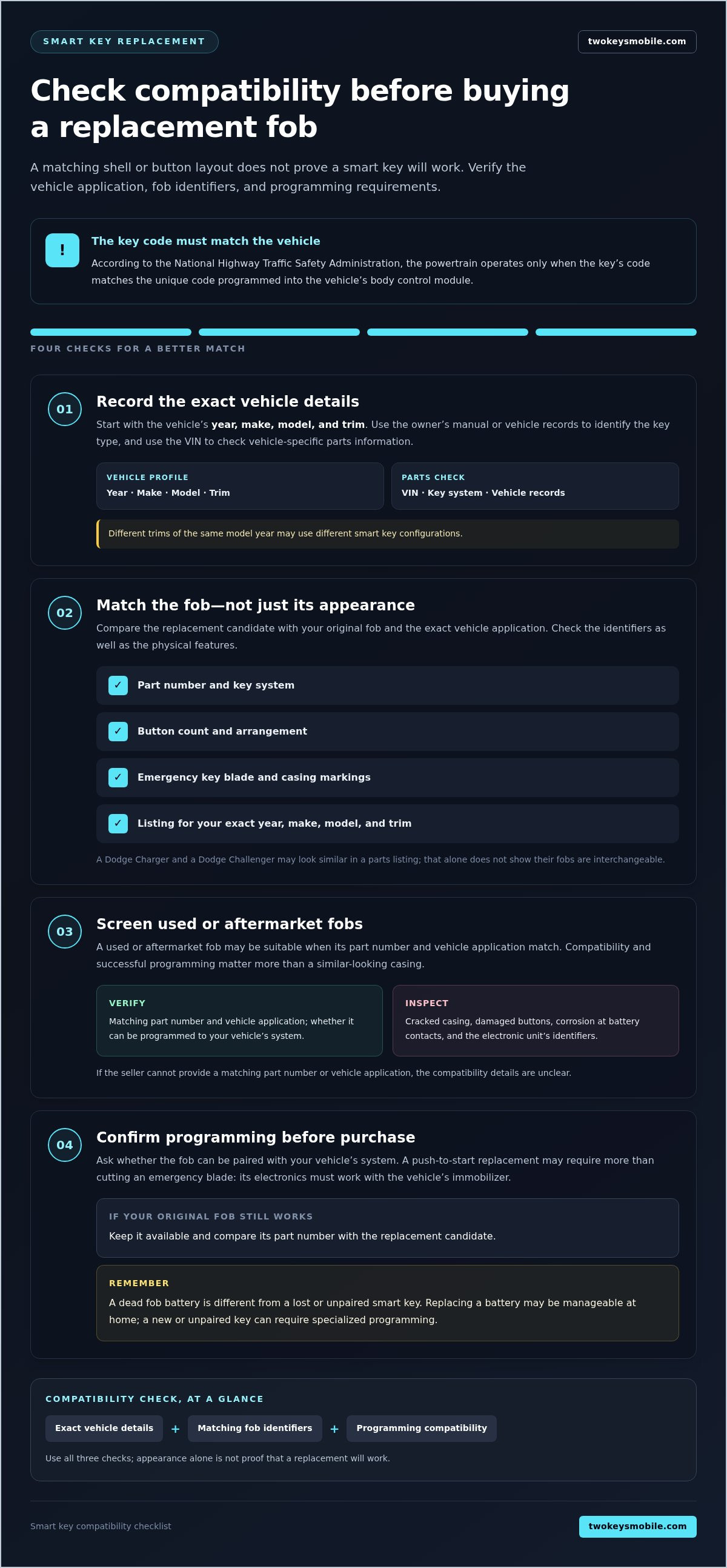
Identify the vehicle’s exact key system before ordering a replacement. A matching shell or button layout alone does not establish compatibility.
- Start with the vehicle’s year, make, model, and trim. Record each detail, then use the owner’s manual or vehicle records to identify the key type. For example, two trims of the same model year may use different smart key configurations. Use the VIN to check vehicle-specific parts information, then compare the key details with the existing fob or its part number.
-
Check Vehicle Compatibility
Match the replacement fob’s part number and key system to your vehicle instead of relying on appearance. Check the model year, trim, button layout, and any identifying number on the original fob. According to the National Highway Traffic Safety Administration, the powertrain operates only when the key’s code matches the unique code programmed into the body control module. Compatibility is essential.
- Compare the original fob’s physical features with the replacement candidate. Note the number and arrangement of buttons, the emergency key blade, and any markings on the casing. Then confirm the candidate is listed for the exact vehicle details you recorded, not merely a related model. A Dodge Charger and a Dodge Challenger may look similar in a parts listing, but that alone does not show their fobs are interchangeable.
-
Assess Aftermarket or Used Key Fobs
Consider an aftermarket or used fob only when its part number and vehicle application match your car. These fobs can be suitable, but reliability depends on compatibility and successful programming. A similar-looking casing does not prove the electronics will work. Before buying, ask whether the fob can be programmed to your vehicle’s system, especially if it has been used before.
Inspect the fob for a cracked casing, damaged buttons, or corrosion around the battery contacts. A worn shell can hide damage, so check the electronic unit and its identifiers too. If the seller cannot provide a matching part number or vehicle application, choose a fob with clearer compatibility details.
- Confirm the programming requirement before completing your purchase. The National Highway Traffic Safety Administration says the powertrain operates only when the key’s code matches the unique code programmed into the body control module. Keep your original fob available if it still works, and compare its part number with the replacement. These checks make push to start key replacement more precise and help prevent buying a fob that cannot be paired.
Dealer versus mobile locksmith service
Compare the complete replacement process, not just the key. Your vehicle’s location, key system, and need for towing can determine which option is practical.
- Ask what the dealership’s process involves for your vehicle’s make and model. A dealer can use manufacturer-specific systems, but you may need to arrange transport if the car cannot be driven. A replacement involving towing and waiting can take 1-3 days. Include that time in your decision, especially if the vehicle is stranded or you rely on it daily.
If you choose a dealership, identify one that supports your vehicle’s brand and ask what its replacement process involves. A push-button ignition may require more than cutting an emergency blade. The fob must also be paired with the vehicle’s security system. Compare physical key replacement and programming as separate parts of the job.
- A mobile locksmith can work with the vehicle at its location, which may avoid arranging a tow just to reach a service location. The work may involve identifying the correct fob, programming it, and testing the start function. Since the make, model, and key system shape the process, share those details when describing the problem.
Mobile service is especially relevant if the car is parked somewhere you cannot readily move it. Keep the vehicle accessible and have its identifying details ready. If the problem is a lockout rather than a missing or unpaired key, an emergency vehicle lockout service addresses access, not key programming.
- Compare the full expense, including the replacement fob, programming, transport, and labor. A dealership total may include towing and labor, while on-site service can change transport needs. The price depends on the vehicle, fob type, programming requirements, and transport, and is provided after a quote request. Compare the same work in each estimate.
Check whether each option includes pairing and a functional test, not just delivery of a fob. Ask what happens if the new key unlocks the doors but does not start the vehicle. The key’s electronics and the car’s immobilizer must work together.
- Choose based on urgency, access, and the vehicle’s requirements. A dealership may suit you if manufacturer-specific handling is your priority and you can manage the wait or transport. A mobile locksmith may be practical if the car cannot be moved easily. Keep a working spare available if you have one. If all keys are lost, say so clearly because the programming steps differ.
Prepare the vehicle’s year, make, model, and location before arranging service. Note whether the fob is lost, damaged, or present but unresponsive. These details help distinguish a key replacement from a lockout and clarify the work needed. Compare the complete process rather than assuming one option is faster or cheaper.
On-site replacement time by scenario
Coverage depends on your policy, roadside plan, or warranty terms, including whether programming or only towing is covered. To reduce unauthorized access, keep keys secure and have a lost fob removed from the vehicle’s authorized-key memory during reprogramming when the system allows it.
- Allow about 25 minutes for a typical on-site smart key replacement when you have one working spare. The working key can help identify the vehicle’s system and support the programming process. Keep it with you, along with the vehicle, so the replacement can be paired and tested on-site.
Use the estimate as a baseline, not a promise for every vehicle. The replacement fob still needs to match the car’s system, and programming steps vary by make and model. A vehicle with a complex security setup may take longer than one requiring straightforward pairing. Tell the technician whether the spare starts the car and operates its keyless-entry functions.
- Plan for 30-60 minutes on-site when all keys are lost and the vehicle needs a full immobilizer reprogram. The exact time depends on the vehicle. With no working key available, the process must establish a new authorized key for the car’s security system, rather than simply pairing another fob beside an existing one.
Share the vehicle’s year, make, and model before the appointment. Explain whether the original fob is missing, damaged, or present but unresponsive. Those details help distinguish an all-keys-lost situation from programming a single fob. Keep the vehicle accessible for programming and starting checks.
- Set aside about 20 minutes for programming a customer-supplied push-to-start fob on-site. That estimate covers programming, not time spent finding or purchasing the right fob. The supplied key must be compatible with the vehicle before programming can proceed. A fob that cannot pair may require a different replacement and additional work.
Bring the fob and its identifying details to the appointment. Say whether it is new or used, and whether its buttons or casing show damage. After programming, test the start function and keyless entry. A button responding does not prove the fob will start the car.
- Prepare for the appointment to keep the work focused. Park where the vehicle’s doors and ignition are accessible, and gather any working spare. Have the vehicle identification and key details ready. If the car also has an ignition fault, describe those symptoms separately. Programming a fob will not repair a mechanical ignition problem.
Include coverage questions in your planning. Review your insurance policy, roadside assistance plan, and warranty wording for replacement, programming, towing, or lockout terms. Keep any claim instructions handy. These documents can clarify which costs may be eligible, while the vehicle’s key system determines the programming work and its duration.
Replacement costs with and without a working spare
Compare the fob, programming, and any transport separately. A working spare can change the work required, while losing every key may require a full immobilizer reprogram.
- Break the replacement down into its main cost factors. The fob, programming labor, vehicle make and model, and availability of a working key all affect the total. A smart key’s electronics and security programming involve more work than replacing its outer shell. Ask for an estimate that separates the replacement part from programming and other charges.
The price depends on the vehicle, fob type, programming requirements, and transport, and is provided after a quote request. Compare estimates for the same work, including pairing the key and testing its functions. An estimate for the fob alone cannot be compared directly with one that includes programming.
- Keep a working spare available and explain its condition. A functioning key can help identify the vehicle’s system and may allow a replacement to be paired without starting from an all-keys-lost situation. The spare must still operate the vehicle. A cracked shell with unresponsive electronics may not help with programming.
Describe exactly what works. For example, say whether the spare unlocks the doors and starts the car. This helps distinguish a replacement-key job from a fob battery or ignition problem. If the car starts with the spare, bring it to the appointment and have the new key’s functions tested alongside it.
- Say clearly if every key is missing. With no working spare, the vehicle may need a full immobilizer reprogram instead of adding a key from an existing one. That changes the procedure and can increase labor. The vehicle’s make, model, security system, and accessibility all affect the work involved.
Do not compare an all-keys-lost estimate with one for adding a spare. They describe different jobs. Confirm whether the estimate includes a compatible fob, programming, and a functional test. Account for towing separately if needed, since a car that cannot be driven may need transport to the service location.
- Check whether the fob is actually the problem before paying for a replacement. A depleted fob battery can cause an unresponsive key, while a damaged key or failed ignition requires different work. A replacement key will not repair an ignition fault, and ignition repair will not supply a missing programmed fob.
Describe the symptoms, available keys, and vehicle details when requesting an estimate. Include whether the car starts, whether the door buttons respond, and whether the ignition behaves normally. These details help identify the required work and avoid comparing a battery fix with a complete smart-key replacement.
What information and documents are needed to get a replacement car key?
Prepare the vehicle details, proof connecting you to the car, and information about every working key. These details help identify the right fob and the programming required.
- Write down the vehicle’s year, make, model, and trim. Include the VIN, which identifies the specific vehicle and helps distinguish similar models with different key systems. Find it on the registration or insurance card, or at the lower windshield. A model’s trim can affect which smart-key system it uses, so do not rely on the model name alone.
Note the car’s location and whether it can be accessed. A vehicle parked in a garage may need different preparation than one in a public lot. Accurate details help distinguish a replacement-key request from an ignition issue.
- Bring a government-issued photo ID and a document linking you to the vehicle, such as its registration or title. Keep the documents together and make sure the name and vehicle information are readable. These records help establish who is requesting a key and which car needs service, reducing delays caused by searching through paperwork during the appointment.
If the vehicle belongs to someone else, have the owner available to provide the relevant documents and information. For a company vehicle, prepare fleet or ownership paperwork identifying the vehicle and the person authorized to request the work.
- Describe the key situation precisely. State whether all keys are lost, one working spare remains, or the fob is present but damaged or unresponsive. Bring any working spare and the old fob, even if its buttons no longer respond. The casing may have a part number or markings that help identify the replacement type.
Note which functions still work. For example, say whether the fob unlocks the doors, opens the trunk, or starts the vehicle. These symptoms help distinguish a depleted fob battery from a damaged key, programming problem, or ignition fault.
- Gather the owner’s manual and any key paperwork you have. The manual can explain the vehicle’s keyless-start features, while a prior key receipt may show the fob’s part number. Keep insurance details available if you plan to ask about coverage, and refer to the policy wording for claim terms.
Before arranging service, place the VIN, ID, vehicle document, and available keys together. For a replacement request, arrange automotive key replacement with those details ready. Clear information helps match the vehicle, identify the work, and prepare for programming and testing.
Two Keys Mobile: Automotive Key Replacement
Two Keys Mobile provides automotive key replacement for drivers with a lost, damaged, or unresponsive car key. Use this service when a fob needs replacement and programming, rather than a simple battery change. Share your vehicle’s year, make, model, and key situation so the replacement can be matched to the vehicle.
If the car is locked and you cannot access the interior, emergency vehicle lockout service addresses the access problem. A lockout and a missing programmed key are different issues, so describe what happened and whether a working key remains. That distinction helps identify the right next step without confusing entry service with key replacement.
Have your vehicle details and relevant ownership documents ready. Contact Two Keys Mobile online to discuss automotive key replacement.
Make Your Next Key Issue Easier to Handle
A replacement is a good time to create a simple backup plan. Keep a working spare in a secure, consistent place, and save the replacement fob’s identifying details with your vehicle records. That preparation can make a future key problem easier to explain and resolve.
For push to start key replacement, choose the next step that fits the problem: a depleted fob battery differs from a lost key, while a locked vehicle may need access help first. Two Keys Mobile offers automotive key replacement and emergency vehicle lockout service. It also provides residential rekeying for home security needs.
When you’re ready, share your vehicle details and describe what happened. Contact Two Keys Mobile for key replacement and take the next step toward restoring access.
Frequently Asked Questions
Can I replace a push-to-start key myself?
Yes, you can replace a fob battery or casing yourself when that is the only problem. Replacing and pairing a complete smart key is different because the vehicle must recognize its electronic code. According to the National Highway Traffic Safety Administration, the powertrain operates only when the key’s code matches the unique code programmed into the body control module. If the replacement will not pair, the car may not start.
Which tools are needed for the installation?
For a routine fob replacement, a screwdriver will not perform the electronic pairing. Programming requires equipment designed for the vehicle’s key system. A small screwdriver may help open some fob casings to replace the battery. Do not confuse key replacement with installing an aftermarket push-button start conversion kit. That separate wiring project can involve a drill, screwdriver, wire stripper, voltage tester, and multimeter.
Why does losing my only push-to-start key cost more?
Losing the only key removes the working reference used when adding another key. The vehicle may need a full immobilizer reprogram to recognize a new authorized fob. This differs from pairing an extra fob while a working key remains. The exact process depends on the vehicle’s security system and whether the car can be accessed for programming.
What does a replacement key fob for a push-to-start car cost?
The price depends on the vehicle’s make and model, the fob type, programming labor, and whether a working spare is available. A replacement part alone does not necessarily include pairing or testing. For a case-specific quote, provide the vehicle details and explain whether all keys are lost, a spare works, or the existing fob is damaged.
How much does a dealership charge to replace and program a push-to-start key?
Dealership pricing depends on the vehicle, replacement fob, programming work, and labor. Transport can add to the overall expense if the car cannot be driven to the dealership. Ask for an estimate that separates the fob, programming, labor, and towing, if needed. This makes it easier to compare the complete job rather than the replacement part alone.
Can an automotive locksmith replace a push-to-start key fob?
Yes. An automotive locksmith can replace a compatible smart fob and handle the vehicle’s key programming. This can help when the car is parked where it cannot be driven to a service location. Two Keys Mobile serves drivers in Little Rock, North Little Rock, Maumelle, Conway, Sherwood, Jacksonville, Cabot, Beebe, Bryant, Benton, East End, Mabelvale, and Mayflower. Prepare the vehicle details and key information before arranging help.
How do you replace and program a push-to-start key fob?
First, identify the vehicle and match the replacement fob to its key system. Then connect programming equipment to the vehicle, pair the fob’s code, and test its functions. Testing should include starting the car and using the buttons that matter to you, such as the door locks. If all keys are lost, tell the technician before work begins because the programming procedure changes.
How long does it take to replace a push-to-start key?
On-site programming typically takes about 20 minutes for a customer-supplied fob. A typical replacement with one working spare takes about 25 minutes. If every key is lost and a full immobilizer reprogram is needed, allow 30-60 minutes on-site, depending on the vehicle. These estimates cover the replacement work, not travel or time spent obtaining a compatible fob.


