
What if someone you’ve never met still has a working key to your new home? Previous owners, tenants, contractors, or neighbors may have had copies, and there’s no simple way to know where every key ended up. Rekeying house after moving gives you a practical way to reset access without automatically replacing every lock.
The right plan depends on the condition of your locks, the doors they secure, and how many locks you want to operate with one key. Rekeying changes which keys work with existing hardware; replacing a lock means installing new hardware. Knowing the difference helps you decide what to prioritize instead of adding guesswork to an already crowded moving-day list.
This guide explains when rekeying makes sense, which entry points to prioritize, and how to coordinate the work around your move. You’ll also learn what to note before arranging a locksmith visit. Two Keys Mobile provides on-site residential rekeying and lock installation in Little Rock and surrounding Central Arkansas communities, helping homeowners plan move-in access around their existing locks.
Key Takeaways
- Rekeying house after moving can stop old keys from operating functional, compatible locks.
- Understand what changes when a lock is rekeyed, and when replacing the hardware may make more sense.
- Use a door-by-door checklist to identify priority entries, including exterior doors and garage access points.
- Plan the work around your move by listing the locks and household access needs you want addressed.
- Two Keys Mobile provides on-site residential rekeying and lock installation in Little Rock and surrounding Central Arkansas communities.
Why rekeying a house after moving can restore control of your keys
Can you know who still has a working key to your new home? The keys handed over at move-in tell you how many copies you received, but they rarely prove that every copy has been returned. That uncertainty is a practical reason to consider rekeying house after moving. It doesn’t mean a previous resident or anyone else kept a key. It means you may not have a complete record of who received one.
Rekeying changes the keying inside a lock cylinder so the old keys no longer operate it. A locksmith adjusts the cylinder to work with a new key while retaining compatible existing lock hardware. After a successful rekey, the previous key should no longer open that cylinder. For a general overview of rekeying a lock, see Wikipedia’s explanation of the process and its uses.
This can be a practical reset when the locks work properly and the concern is access, not the hardware itself. You keep compatible locks in place while changing which keys operate them. Collecting old keys or asking for them back is not a substitute: neither step changes how the locks respond.
Who might still have a key to the home?
Over time, keys may have been given to previous owners, former tenants, household members, contractors, or other people who needed access. That list describes possible keyholders, not proof that anyone kept a copy. Even if you receive several keys at move-in, you may not know whether they represent every copy. Rekeying addresses that uncertainty by changing access at the lock instead of relying on a complete key handover.
When should rekeying happen after a move?
Plan the work soon after taking possession, ideally before you rely on the home as secured under your new key. First consider when household members need access and which doors they use every day. If you’re moving in stages, prioritize exterior entry points, then plan other relevant doors around your household’s needs. This gives you a sensible order of work without making a complete home checklist a prerequisite for moving in.
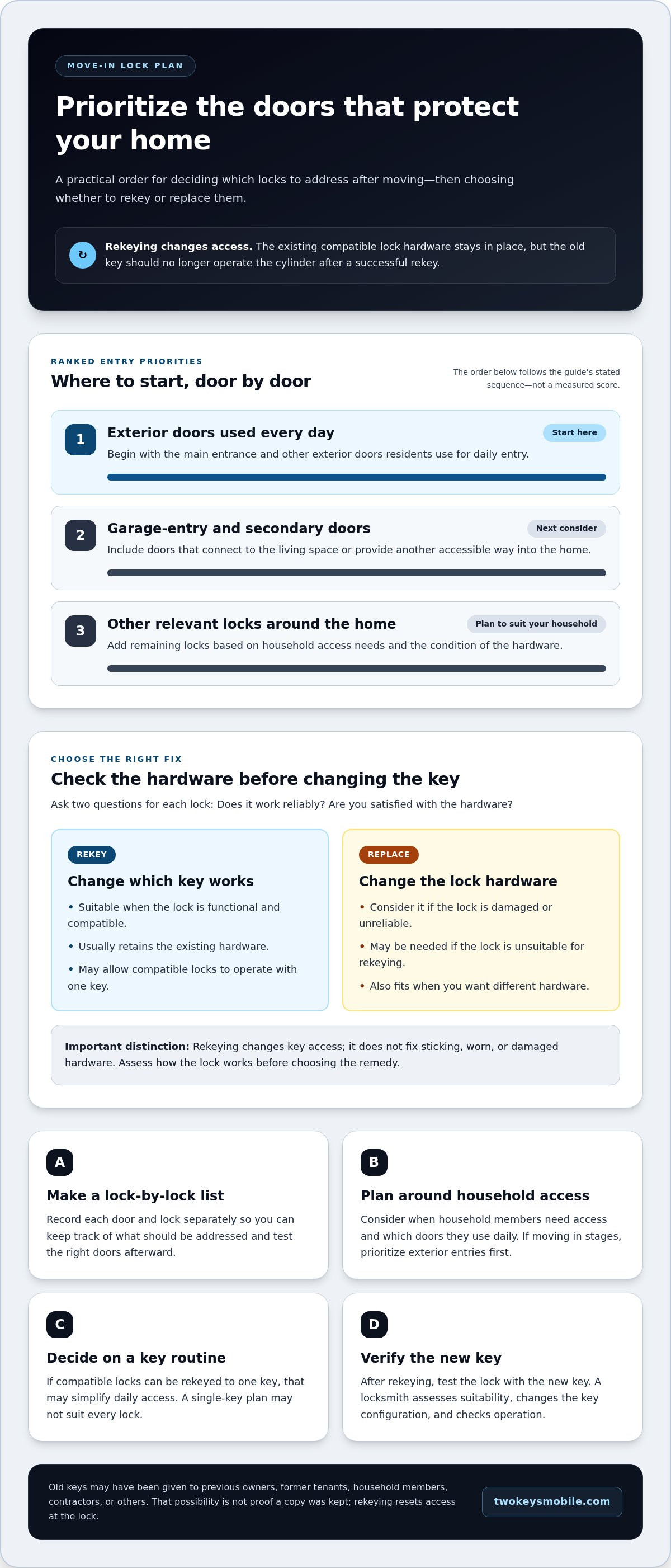
Start with entries that protect the living space, including the main entrance and other exterior doors used by residents. Then consider garage-entry and secondary doors that connect to the home. Once you’ve identified the priority locks, you can organize the rest of the work around your household’s access needs and the condition of the existing hardware.
How house rekeying works and what changes when the locks are rekeyed
Rekeying changes how an existing lock cylinder responds to a key. The lock hardware usually stays in place, but its internal key configuration is adjusted to work with a new key. After a successful rekey, the previous key should no longer operate that cylinder. The door, handle, and lock remain the same; access changes.
What happens during a residential rekey?
A locksmith first assesses the lock and determines whether its cylinder can be rekeyed. If it’s suitable, the cylinder’s key configuration is changed, then the lock is tested with the new key to confirm it operates properly. The process depends on the lock’s condition and compatibility. Rekeying house after moving can reset key access without replacing functional hardware, but it won’t repair a lock that is damaged or unsuitable for rekeying.
Separate the key change from the hardware assessment
Rekeying addresses which key operates the lock. It doesn’t automatically correct sticking, worn, or damaged hardware. If a lock doesn’t function reliably or can’t be rekeyed, replacement may be the more appropriate option. Treat these as two parts of the decision: assess whether the lock works as it should, then determine whether changing its key access is suitable. That helps you plan for rekeying, replacement, or a combination across the home.
Which doors and locks should be included?
Start with exterior doors used for daily entry, then consider other accessible entry points. Include a garage-entry door or a secondary door if it provides access to the living space. List each lock separately so you can track what should be addressed and test the right doors afterward.
Think about the key routine you want. If compatible locks can be rekeyed to operate with one key, that may simplify daily access. Compatibility matters, so a single-key plan may not apply to every lock in the home. Two Keys Mobile can assess the hardware and rekey suitable residential locks based on the doors you’ve identified.
For on-site residential rekeying in Little Rock and surrounding Central Arkansas communities, Two Keys Mobile’s residential rekeying service can help you plan the work around your home’s existing locks.
Rekeying versus replacing locks after moving: how to choose
Should you change the keys or the locks themselves? Start with two questions: Does the lock work reliably, and are you satisfied with the hardware? Rekeying changes which key operates a compatible lock. Replacement changes the lock hardware. Neither option is automatically right for every door.
| Option | What changes | Hardware retained | Suitable situations |
|---|---|---|---|
| Rekeying | The lock’s key configuration | Usually, if the lock is compatible and functional | You want to change key access without changing the existing lock |
| Replacement | The lock hardware and its key setup | No, the existing lock is replaced | The lock is damaged, unreliable, unsuitable, or you want different hardware |
When rekeying may be the practical choice
If the existing lock operates smoothly and you’re comfortable keeping it, rekeying may address the main concern: who can use the old keys. It changes key access while retaining compatible hardware, which can simplify a move-in plan when the current locks are in usable condition. Each lock still needs an individual assessment because compatibility and condition can vary from door to door.
For example, a home may have a working front-door lock that fits your needs, but you want keys issued before your move to stop operating it. Rekeying may suit that lock. Don’t assume the same answer applies to every entry, especially if another lock sticks, feels unreliable, or shows visible wear.
When replacing a lock may make more sense
Consider replacement if the lock is damaged, operates unreliably, or doesn’t suit the setup you want. A new lock changes the hardware itself, rather than only changing its key configuration. Replacement may also make sense if you want a different style or arrangement. Base the decision on the specific lock and door, rather than assuming one approach is always safer.
During rekeying house after moving, you may find that some doors are candidates for rekeying while others need new hardware. Decide lock by lock. Note any sticking, damage, or hardware you’d prefer to change, then have the existing locks assessed. This gives you a clear plan based on function and access needs, not an assumption that every lock should receive the same treatment.
A move-in checklist for deciding which house locks to rekey
A door-by-door plan helps you focus on locks that control access to your living space and avoid overlooking secondary entries. Use this checklist to organize rekeying house after moving around how your household actually uses the home.
- List every keyed entry. Include the front, back, and side doors, garage-entry doors, and any other doors with keyed locks. Mark exterior doors and any door connecting a garage or shared area to the home as priorities.
- Check how each lock operates. Note locks that stick, feel unreliable, or show visible damage. This helps distinguish locks that may be candidates for rekeying from those that may need a hardware change.
- Decide who needs access. Consider household members, roommates, and trusted support such as caregivers. Plan how many keys are appropriate and avoid distributing copies more broadly than needed.
- Set a key plan. Record which doors you’d like to operate with the same key, if the locks are compatible. Gather the keys provided at move-in, but don’t assume they represent every copy in circulation.
Inventory doors, keys, and household access
Keep your list practical. For example, a home with a front entrance, a back door, and a garage-entry door may have different daily access needs at each point. Include contractors or other people only if they need ongoing access, and consider how their access fits your household’s key routine. Two Keys Mobile can assess the condition and compatibility of each lock as part of planning residential rekeying.
If several compatible locks should use one key, note that preference on your list. If different household members need access to different doors, record that too. A clear plan helps you avoid rekeying a door outside your priorities or overlooking one that matters.
Turn the checklist into a rekeying plan
Group the doors by priority: exterior entries first, followed by garage or shared-area connections, then other keyed doors you want included. This creates a useful sequence if the work needs to fit around move-in tasks. For a broader overview, see the Central Arkansas residential rekeying information.
For on-site service, explore residential rekeying with Two Keys Mobile. Bring your door list and access priorities so the plan can account for your home’s locks and the people who need entry.
Arrange house rekeying in Little Rock and surrounding Central Arkansas communities
If your locks work properly and are compatible with rekeying, the decision is straightforward: rekey them when your concern is who can use the existing keys. If a lock is damaged or you want different hardware, lock installation may be a better fit. For rekeying house after moving, a mobile locksmith can assess the locks at your home and organize the work around the doors you’ve prioritized.
Two Keys Mobile provides mobile residential rekeying and lock installation in Little Rock, North Little Rock, Maumelle, Conway, and surrounding Central Arkansas communities. When arranging the work, note your property location, the number of doors you want addressed, and any known concerns, such as a sticking lock or visible damage. A clear door list helps keep the visit focused on your move-in access plan.
What to expect when arranging mobile rekeying
At the property, the technician assesses each lock’s condition and suitability for rekeying. Compatible, functioning locks may be rekeyed; a damaged or unsuitable lock may call for a hardware change instead. The technician tests the locks and new keys as part of the work, so you can confirm that the rekeyed locks operate with the new keys.
Before the appointment, note which exterior doors you use every day, whether garage or secondary entries connect to the home, and who in your household needs access. If you want compatible locks to work with one key, include that preference in your plan. The assessment can account for the actual locks on each door instead of assuming they all need the same work.
Take the next step with a local mobile locksmith
Two Keys Mobile brings residential rekeying and lock installation to homes across its Central Arkansas coverage area. Each mobile technician has more than 12 years of industry experience, bringing practical knowledge to the on-site assessment and rekeying process.
Gather your door list, note any lock concerns, and decide who needs keys. Then arrange residential rekeying with Two Keys Mobile to put a clear move-in security plan into action.
Make your new home’s key access your own
Rekeying house after moving gives you a clear way to reset access when you can’t know who may still have a copy of an old key. If existing locks are functional and compatible, rekeying can change which keys operate them while keeping the hardware in place. If a lock is damaged or you want a different setup, replacement may be the better fit.
Start with the exterior doors and any garage or secondary entry connected to your living space. Make a list of the locks, note any concerns, and plan which household members need keys. A little preparation helps keep the work focused and move-in security easier to manage.
Two Keys Mobile provides mobile residential rekeying and lock installation in Little Rock and surrounding Central Arkansas communities. Each technician brings more than 12 years of industry experience. Arrange residential rekeying with Two Keys Mobile to take a practical next step toward feeling settled in your new home.
Frequently Asked Questions
Should I rekey my house after moving?
Yes, rekeying is a practical way to change who can operate your existing locks when you don’t know how many keys are still in circulation. Rekeying house after moving can be especially useful for exterior doors and other entries into your living space. Two Keys Mobile provides mobile residential rekeying across Little Rock, North Little Rock, Maumelle, Conway, Sherwood, Jacksonville, Cabot, Beebe, Bryant, Benton, East End, Mabelvale, and Mayflower.
Is rekeying the same as changing the locks?
No. Rekeying changes a lock cylinder’s key configuration so a new key operates it, while keeping compatible hardware in place. Changing the locks means replacing the lock hardware. Rekeying may suit a functional lock when your goal is to change key access. Replacement may make more sense if the lock is damaged, unreliable, or you want a different setup. The lock’s condition and compatibility help determine the right option.
How soon should I rekey a house after moving in?
Plan to rekey soon after taking possession, ideally before relying on the home as secured under your new key. Prioritize exterior doors used for daily entry, then consider garage-entry or secondary doors that connect to your living space. If your move is happening in stages, coordinate the work around household access so residents can use the doors they need while you address the most important entries first.
Can all the locks in my house be rekeyed to one key?
Sometimes. Multiple locks may be rekeyed to use one key if they’re compatible, but the locks must be assessed individually. Different lock types or key configurations may prevent a single-key setup across every door. Make a list of the locks you’d like to share a key and include that preference in the plan. This gives the locksmith a clear picture of your ideal key routine and the hardware involved.
Do I need to rekey every door after moving?
Not necessarily. Start with exterior entry doors, then include doors from a garage or shared area into the home and any other keyed entry points that matter to your household. The right scope depends on how the doors are used, who needs access, and each lock’s condition and compatibility. A door-by-door list helps you set priorities without assuming every lock needs the same work.
How much does it cost to rekey a house after moving?
The total depends on the number of locks, their condition and compatibility, and the work required at the property. A home with several different lock types may need a different plan from one with compatible, functional locks. Listing the doors and noting any issues, such as sticking or visible damage, helps clarify the scope. Two Keys Mobile’s technicians each bring more than 12 years of industry experience.
Will my old key still work after a lock is rekeyed?
No. After a lock cylinder has been successfully rekeyed, the previous key should no longer operate that cylinder. The new key is tested with the lock as part of the work. This applies to the rekeyed lock, not automatically to every door in the home. If you want several doors addressed, include each one in your plan and have its operation checked.


