
You slide behind the wheel, insert your key, and nothing moves. When your car ignition won't turn, locksmith professionals will tell you that the culprit is rarely a broken engine or an electrical meltdown. In most cases, it is a straightforward lock hardware failure. Forcing the blade risks snapping metal inside the tumbler, leaving you stranded with an even bigger headache.
Facing a jammed ignition is frustrating, especially when you picture the steep prices of a dealership repair and the hassle of arranging a flatbed tow. The good news is that you don't need an expensive service garage to solve this problem. A skilled mobile technician can diagnose internal wafer damage, cut a factory-spec key, or rebuild your existing lock cylinder directly on-site, saving you both time and unnecessary stress.
In this guide, you will uncover the most common reasons your ignition cylinder locks up, discover simple checks you can perform right now, and see how mobile ignition service gets you moving again without a tow truck.
Key Takeaways
- Learn why choosing a car ignition won't turn locksmith specialist eliminates the need for expensive dealership towing and extended repair delays.
- Pinpoint the real mechanical causes behind ignition lock failures, including worn key profiles, bound steering locks, and jammed internal wafers.
- Protect your vehicle from further damage by knowing which common quick fixes, like pliers and household oil sprays, actually ruin lock cylinders.
- Understand how mobile technicians rebuild or rekey your original cylinder on-site so you never have to juggle mismatched car keys.
- Explore how on-demand mobile services across Central Arkansas get you back behind the wheel without ever setting foot in a service garage.
What Does It Mean When Your Car Ignition Won’t Turn?
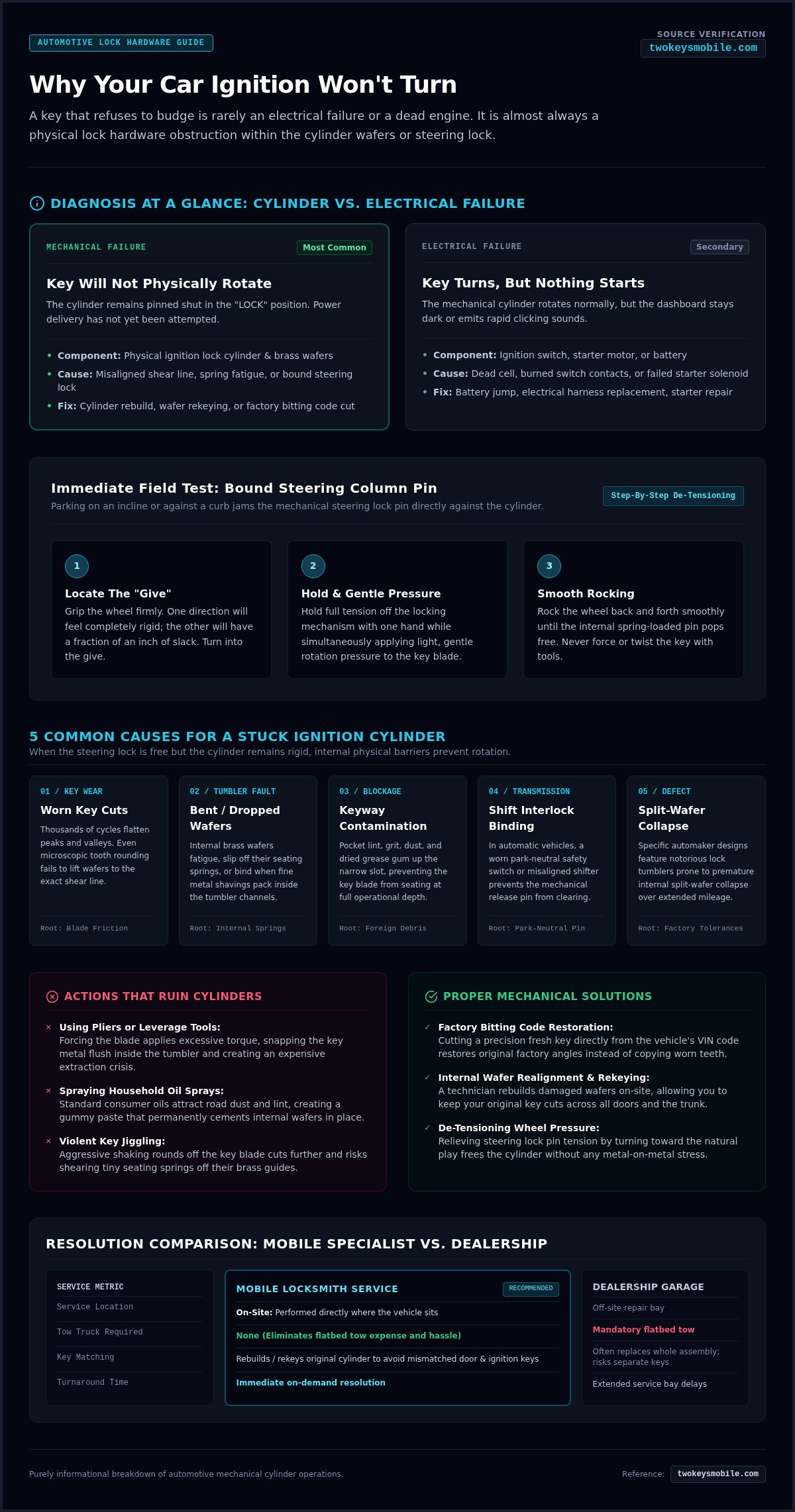
A frozen key does not mean your vehicle's engine is shot. Drivers often fear a dead battery or a broken starter motor when their key refuses to budge. In reality, those electrical failures cause clicking sounds or silent dashboards after the key rotates. If the key physically will not rotate from the "lock" position, you are dealing with a purely mechanical obstruction.
Your ignition cylinder is a dedicated mechanical lock that relies on internal brass components called wafers. Each wafer sits on a tiny spring and features a precise central cutout. Inserting the correct key pushes these wafers to an exact alignment point called the shear line. If even one wafer sticks, bends, or fails to raise high enough, the cylinder stays pinned shut. When a car ignition won't turn, locksmith specialists assess whether the failure stems from the key profile, these internal wafers, or the surrounding steering column mechanics.
Ignition Cylinder vs. Ignition Switch
The ignition cylinder serves as the mechanical gatekeeper of your vehicle's power, operating independently from the electrical switch hidden behind it.
Many auto parts resources mistakenly label every startup failure as an electrical issue. However, inserting your key engages the physical cylinder, while the switch behind it simply routes power to the starter and dashboard once rotation occurs. Locksmiths focus on repairing or rebuilding the physical cylinder, realigning jammed wafers, and cutting exact factory keys rather than replacing complex wiring harness assemblies.
The Role of the Steering Wheel Lock
Modern vehicles feature an integrated mechanical lock that engages when the steering wheel turns after key removal. Parking on an incline or turning your wheels against a curb puts heavy mechanical tension on the steering column pin. This tension directly binds against the ignition cylinder, stopping the key dead in its tracks.
You can quickly tell if your steering wheel is bound. The wheel will feel completely rigid in one direction and give only a fraction of an inch in the other. If you find yourself in this situation, do not force the key with tools. Instead, use these steps to release the pressure:
- Grip the steering wheel with one hand and turn it firmly in the direction that has slight give.
- Hold that tension off the lock mechanism while simultaneously applying gentle turning pressure to the key.
- Rock the wheel back and forth smoothly until the spring-loaded pin pops free and the cylinder turns.
If the wheel moves freely but the key still refuses to budge, internal wafer fatigue or key blade wear has taken over. In that scenario, calling an on-site professional specializing in car ignition won't turn locksmith repairs is the safest path forward to avoid snapping the key.
5 Common Reasons for a Stuck Ignition Cylinder
When the steering wheel lock is disengaged yet the cylinder remains rigid, internal physical barriers are almost always at play. Years of daily operation, friction, and environmental contamination gradually wear down tight mechanical tolerances. Five specific root causes explain the vast majority of stuck ignitions:
- Worn Key Cuts: Daily friction flattens the distinct peaks and valleys along the key blade.
- Bent or Dropped Wafers: Internal brass tumblers fatigue, slip off their seating springs, or bind within their channels.
- Keyway Contamination: Pocket lint, grit, or dried lubricant gum up the chamber and block full key insertion.
- Shift Interlock Binding: In automatic vehicles, a worn park-neutral switch or misaligned shifter prevents the mechanical release pin from clearing the cylinder.
- Factory Assembly Defects: Specific automakers feature notorious ignition designs prone to internal split-wafer collapse over extended mileage.
Key Wear and Tear
Car keys endure thousands of turns over their lifetime. Even microscopic rounding along the key's teeth prevents it from lifting wafers to the precise shear line required for rotation. Modern vehicles complicate this dynamic because transponder heads house RFID chips. If an ignition locks up, cutting an unprogrammed metal blank tests rotation, but a permanent fix requires pairing the electronics. Scheduling a precision car key replacement Little Rock drivers trust often solves the problem instantly by restoring factory-fresh bitting codes derived from your vehicle's VIN.
Mechanical Failure of Internal Wafers
Inside the cylinder housing, split brass wafers balance on delicate springs. Metal shavings ground off old keys settle inside these tiny channels, eventually jamming a wafer half-extended. When this happens, drivers instinctively jiggle the key with increasing aggression. This is dangerous. Excessive shaking or using pliers snaps the thin metal blade flush inside the keyway, turning a basic service into a complex broken-key extraction.
Some DIY guides suggest spraying standard penetrating oils like WD-40 straight into the keyway. That advice causes lasting damage. Oil-based sprays attract dust, dissolve residual grease into thick sludge, and permanently gum up spring channels. Mobile technicians carry specialized electrical contact cleaners and ultra-fine dry graphite sprays that flush out debris without leaving sticky residues behind.
If testing your spare key reveals that internal hardware has collapsed, calling a skilled car ignition won't turn locksmith allows a mobile technician to decode your cylinder and rebuild damaged wafers right at your vehicle's location.
Locksmith vs. Dealership: Finding the Best Solution
When facing a locked cylinder, many drivers default to calling their local auto dealer. That path usually creates an expensive logistical headache. Because a vehicle with a seized lock cylinder cannot steer or shift out of gear, getting it onto a flatbed wrecker adds immediate towing fees to your repair bill. Dealerships then park your car in an intake queue, often leaving you without transportation for days while waiting for parts.
Mobile automotive professionals flip that script completely. A mobile technician drives a fully equipped workshop directly to your driveway, office parking lot, or roadside location. When your car ignition won't turn, locksmith specialists evaluate the failure immediately, eliminating towing fees and getting you back on the road in a single visit.
Cost Comparison and Convenience
Dealership service departments rely almost entirely on complete assembly swaps. Rather than addressing the stuck mechanical wafer, technicians frequently replace the entire steering column lock assembly, adding heavy parts markups and diagnostic fees to your invoice. In contrast, an automotive locksmith takes a targeted approach, disassembling the barrel to repair or rekey the specific damaged components.
Opting for an experienced locksmith Conway AR motorists turn to bypasses dealership markups and scheduling gridlock. Modern mobile vans carry computerized key-cutting machines and advanced diagnostic programmers. This mobile setup allows a locksmith to cut a precise, factory-bitted key and sync the vehicle's transponder chip right outside your home.
Expertise and Specialized Tools
Dealership parts counters rarely stock loose wafers or individual tumbler springs. If a dealership replaces your cylinder, they typically install a pre-assembled unit keyed differently from your doors, saddling you with two separate keys for the same car. Automotive locksmiths prevent this headache by carrying specialized pin kits designed to rebuild a replacement cylinder to match your original door key cuts.
Delicate steering column housings require specialized care. With over 12 years of industry experience servicing transponder systems and precision hardware, a dedicated car ignition won't turn locksmith technician knows how to remove trim bezels safely without cracking delicate plastic clips or damaging airbag wiring. You receive an accurate, damage-free repair that keeps your factory security setup intact.
What to Do (and Not Do) When Your Ignition Is Stuck
A frozen key triggers an immediate urge to twist harder. Resist that impulse. Applying heavy rotational torque often snaps the brass or nickel-silver key blade off inside the lock cylinder, transforming a manageable rekey job into an emergency extraction. You risk cracking the internal steering column housing or damaging the delicate anti-theft transceiver collar around the cylinder face.
Before assuming the worst about your mechanical hardware, run through these essential checks:
- Test a Spare Key: An unworn backup key immediately tells you whether the issue stems from rounded teeth on your daily key or collapsed internal wafers.
- Confirm Transmission Placement: Push the shifter firmly forward into "Park," or cycle it into "Neutral" while stepping on the brake pedal to ensure the safety interlock switch releases.
- Verify Battery Voltage: Modern computerized push-turn ignition systems and electronic steering column locks require sufficient system voltage to cycle their release solenoids.
- Avoid Wet Lubricants: Never spray standard household penetrating oils or cooking grease into the keyway.
The 'Jiggle' Technique Done Right
Wiggling a key works only when done with light, controlled finesse. Insert the blade completely, apply minimal turning pressure with your thumb and index finger, and gently vibrate the key inward and outward by a millimeter. At the same time, rock the steering wheel left and right to locate the sweet spot where column pressure drops off.
Stop immediately if you feel the blade flex. Persistent resistance means a wafer has dropped out of its guide channel. Continued force will only shear the metal.
Safe Cleaning Methods
Grit accumulation inside the cylinder barrel can often be cleared using a simple can of compressed gas. Direct the thin straw into the keyway and deliver short bursts to dislodge loose pocket lint and road dust. If the mechanism feels dry, use a tiny puff of dry film PTFE or powdered graphite lubricant designed specifically for automotive pin-tumbler locks.
Skip the viral internet life-hacks involving paperclips, screwdrivers, or heavy hammers. Jamming steel tools into the cylinder gouges the soft brass components, rendering the housing unrepairable. When basic gentle methods produce zero movement, contacting a trusted car ignition won't turn locksmith for on-site ignition repair and replacement prevents expensive collateral damage to your steering column.
Mobile Ignition Repair Services in Little Rock
Getting stranded with a frozen lock cylinder disrupts your entire day. Finding local assistance should not create an extra hurdle. Two Keys Mobile operates as an exclusively mobile automotive service, eliminating brick-and-mortar waiting rooms entirely. We dispatch our technicians straight to your vehicle, whether you are parked at home, outside the office, or stuck along major corridors like I-630, I-30, or I-430.
Our service vans cover Central Arkansas with dedicated 24/7 emergency response. We regularly assist stranded drivers across:
- Little Rock and North Little Rock
- Maumelle
- Conway
- Bryant and Benton
When an unexpected breakdown leaves you with a car ignition won't turn, locksmith professionals from our team bring all required machinery directly to your location. We handle complete ignition repair and replacement, on-site tumbler rekeying, and precision automotive key replacement across all domestic and foreign vehicle makes.
Fast Arrival and On-Site Solutions
Flatbed wreckers often struggle to load vehicles with locked steering columns safely, risking cosmetic and mechanical damage. Our mobile-first model removes the need for a tow truck entirely. Every service van functions as a fully mobile locksmith workshop, stocked with high-security laser key cutters, transponder programmers, and complete replacement tumbler sets.
We believe dependable roadside assistance should remain accessible. That is why Two Keys Mobile backs every job with a lowest-price guarantee for all Central Arkansas residents, ensuring you receive premier on-site labor without dealership price inflation.
Why Trust Two Keys Mobile?
Modern vehicle security requires specialized technical know-how. Arkansas does not maintain a state-level licensing board for locksmiths, making industry tenure and proven skill vital safeguards for consumers. Every Two Keys Mobile technician brings over 12 years of industry experience to the job. We specialize in delicate laser-cut key extraction, complex immobilizer re-syncing, and wafer rebuilds on fragile ignition housings.
Our team prioritizes calm composure, direct communication, and clear upfront pricing so you never face hidden surprises during a stressful emergency. Stuck in a parking lot? Call Two Keys Mobile for fast ignition repair! We will diagnose the mechanical binding, restore smooth key rotation, and get your vehicle moving again on the spot.
Get Back Behind the Wheel Without Dealership Delays
Dealing with a jammed key is stressful, but it rarely demands an expensive flatbed tow or an overpriced dealership invoice. Always check the simple mechanical factors first, such as steering lock tension and transmission placement. When internal wafers wear down or key cuts flatten out, relying on a dedicated car ignition won't turn locksmith specialist ensures you get targeted, on-site hardware repairs without risking a broken key in the keyway.
Two Keys Mobile delivers complete ignition repair and replacement directly to your driveway or parking space. Equipped with over 12 years of industry experience and backed by guaranteed lowest prices in Central Arkansas, our fully mobile units arrive ready to decode, cut, and rebuild your lock hardware on the spot. Don't let a stubborn key disrupt your schedule any longer. Get fast mobile ignition repair in Little Rock now and hit the road again with confidence.
Frequently Asked Questions
Can a locksmith fix an ignition that won't turn?
Yes, an automotive locksmith can quickly repair or rebuild a locked ignition cylinder. Technicians diagnose whether the failure stems from a rounded key blade, jammed wafers, or dirt buildup inside the keyway. Calling a car ignition won't turn locksmith specialist ensures the mechanical tumblers are repaired or replaced on-site, allowing you to turn the key smoothly without having to tow your car to a mechanic.
Is it cheaper to call a locksmith or a mechanic for ignition repair?
Calling a mobile locksmith is almost always cheaper than visiting a dealership or general mechanic. Locksmiths focus on repairing or rekeying the existing cylinder instead of ordering entire replacement assemblies with high markups. Additionally, mobile service eliminates flatbed towing expenses entirely. Technicians handle the diagnosis and precision mechanical rebuild right in your driveway, cutting out standard shop diagnostic fees.
How much does it cost for a locksmith to fix a stuck ignition?
Total repair costs depend on whether the cylinder requires cleaning, pin replacement, or full hardware replacement. Technicians evaluate the vehicle make, model, and key type before providing a firm quote. Two Keys Mobile guarantees the lowest prices across Central Arkansas, offering clear, upfront pricing over the phone so you never have to worry about unexpected surprise charges on your final invoice.
Will a locksmith have to replace my whole ignition system?
No, a full system replacement is rarely necessary. In most cases, a technician extracts the cylinder housing and replaces only the fatigued brass wafers and tiny internal springs. If severe damage does require a brand-new cylinder, the technician rekeys the replacement tumblers on the spot so the new ignition continues working with your existing door keys.
How long does it take for a mobile locksmith to arrive in Little Rock?
Arrival times depend on local traffic and your exact location, but mobile units prioritize rapid emergency response. Two Keys Mobile provides 24/7 service throughout Pulaski County and neighboring communities. Technicians travel directly to stranded motorists in Little Rock, North Little Rock, Maumelle, Conway, Bryant, and Benton with fully stocked service vans ready for immediate work.
Can you rekey my new ignition to my old car key?
Yes, rekeying the cylinder to match your original key cuts is a standard mobile service. Rather than forcing you to carry one key for your doors and a separate key for the ignition, our technicians assemble the internal wafers to your original factory bitting. This preserves single-key convenience across your entire vehicle.
What should I do if my key broke off inside the ignition?
Leave the broken fragment alone and avoid using superglue, tweezers, or paperclips to fish it out. DIY attempts usually push the snapped blade deeper or damage internal wafer springs. When dealing with a snapped key and a car ignition won't turn, locksmith technicians use specialized extraction tools to remove the broken metal cleanly before cutting a factory-spec replacement.
Do you provide ignition services for all car makes and models?
Yes, Two Keys Mobile services virtually all domestic and foreign vehicles on the road today. Each technician brings over 12 years of industry experience, ensuring proper handling of traditional mechanical keys, high-security laser cuts, and computerized transponder systems. We carry the specialized diagnostic decoders required to program security chips right at your vehicle.


