
A locksmith can sometimes make a car key using its VIN, but the VIN alone doesn’t guarantee a working replacement. It may help retrieve the vehicle’s key code, while the make, model, key type, and security system determine what replacement steps are possible. If you’re asking whether a locksmith can make a key from a VIN number, the short answer is yes in some cases, with the right vehicle details and proof of ownership.
Losing your only key is stressful, especially when you need to get back on the road. This guide explains how a VIN may help identify a key code, what vehicle details and ownership documents to prepare, and why mechanical, transponder, and smart keys involve different steps. You’ll also learn what to consider when a VIN-based replacement isn’t the right approach.
Key Takeaways
- A VIN can help a locksmith retrieve a vehicle’s key code, but the vehicle’s make, model, and security system affect the available options.
- Have your vehicle details and proof of ownership ready to help establish that you’re authorized to request a replacement key.
- Identify whether your vehicle uses a mechanical key, transponder key, remote-head key, or smart key, since the replacement steps can differ.
- If a VIN-based replacement isn’t suitable, compare the practical alternatives and consider Two Keys Mobile for automotive key replacement.
Vehicle details and proof of ownership needed for replacement
In some cases, a locksmith can make a key from a VIN by retrieving its key code. Your vehicle details and ownership documents help identify the correct key and support a secure request.
Vehicle Information for Replacement
Give the locksmith the vehicle’s make, model, and VIN. The VIN is a 17-character code, usually found on the dashboard, driver’s-side door frame, or registration documents. Check each character carefully before sharing it; an incorrect digit can lead to the wrong vehicle information. The make and model also matter because key options and manufacturer restrictions vary between vehicles.
Proof of Ownership Documents
Have a government-issued photo ID and vehicle paperwork ready. Common examples include a driver’s license, registration, title, or current insurance document. These records help connect you with the vehicle named in the paperwork. If you’re unsure which document to bring, have your registration and photo ID available so the locksmith can review them alongside the VIN.
Ownership Verification
Vehicle key replacement typically involves checking photo ID and proof of ownership. The name on your ID should match the name on the vehicle paperwork. This helps prevent a VIN from being used as the sole basis for cutting a key. Provide the documents for review, and make sure the VIN on the paperwork matches the identifier on the vehicle’s dashboard or door frame.
A VIN identifies a vehicle; it doesn’t prove ownership. Avoid posting it publicly alongside registration or insurance details. Before using the VIN to retrieve a key code, a locksmith should verify your identification and vehicle ownership. This helps reduce the risk of an unauthorized key request.
There’s no single turnaround time. Code retrieval, key cutting, and any required programming are separate steps, and the vehicle’s make, model, and security system affect the process. A VIN lookup may help identify a key code when the vehicle isn’t present, but electronic programming or function testing may require access to it. If you can’t be there, you’ll still need to provide identification and matching ownership documents.
Alternatives when a key cannot be made by VIN
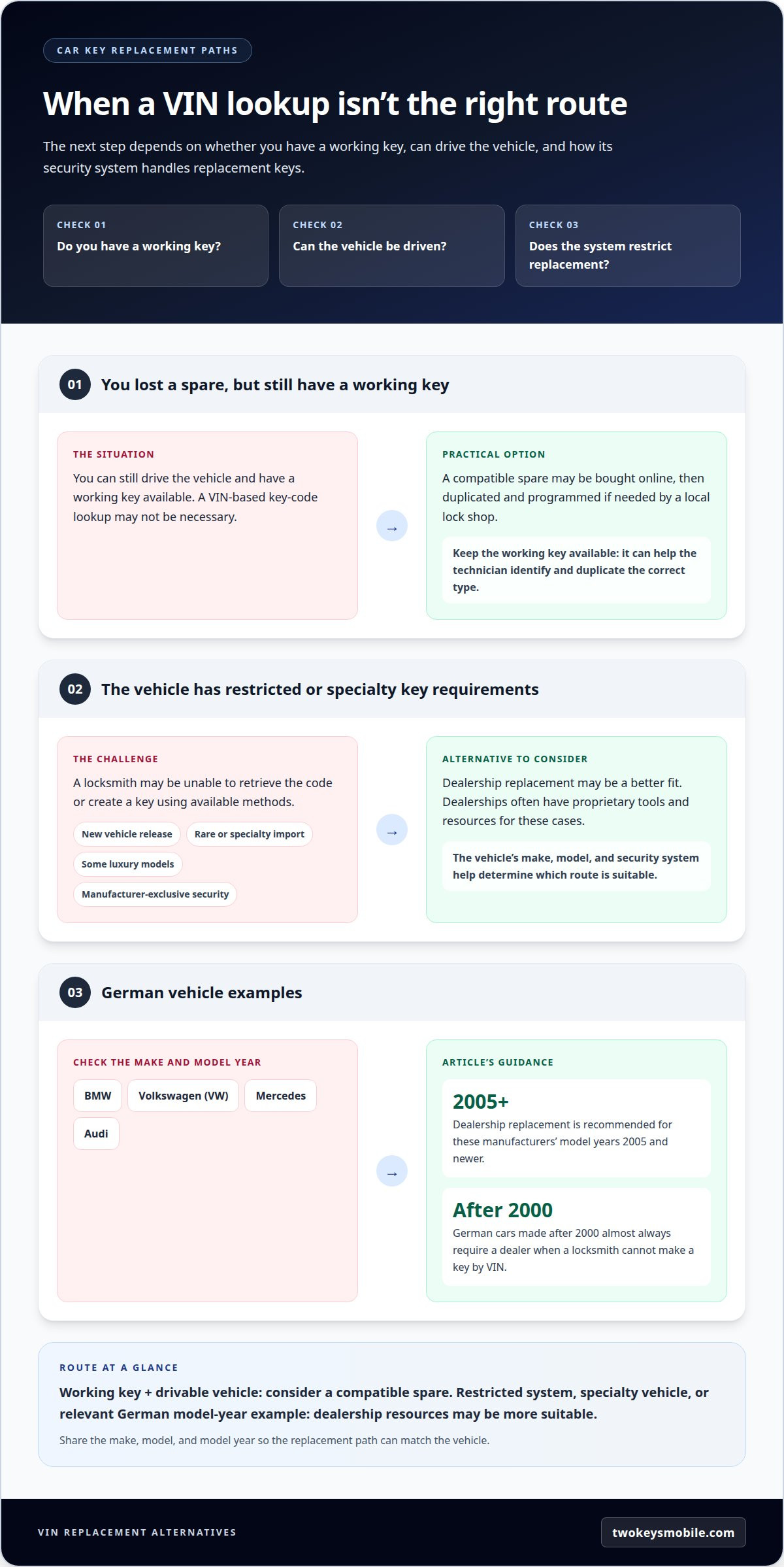
A VIN lookup is one way to replace a car key, but it isn’t the only option. The right alternative depends on whether you have a working key, whether the vehicle can be driven, and how its security system handles replacement keys. An automotive locksmith may be able to use another method; some vehicles require dealership resources.
Use a working key to make a spare
If you’ve lost only a spare key or remote and can still drive the vehicle, buying a compatible spare online may be practical. A local lock shop can duplicate and program it if needed. This may avoid retrieving a key code through the VIN. Keep your working key available, as it can help the technician identify and duplicate the correct type.
Consider dealership replacement for restricted systems
A dealer may be a better fit for a new vehicle release, a rare or specialty import, certain luxury models, or a vehicle with a manufacturer-exclusive security system. Dealerships often have proprietary tools and resources for replacement keys. That access can matter if an automotive locksmith can’t retrieve the code or create a key using available methods. The vehicle’s model and security system help determine which route makes sense.
German vehicle examples
For German manufacturers BMW, VW, Mercedes, and Audi, dealership replacement is recommended for model years 2005 and newer. German cars made after 2000 almost always require a dealer when a locksmith cannot make a key by VIN. These examples show why the model year and manufacturer matter. Identify both before choosing between locksmith-based replacement and dealer service.
Choose the next step
Start by deciding whether you have a working key and whether the vehicle can be driven. If both are true, a compatible spare and local duplication may be an option. If the vehicle has an exclusive security system, belongs to a specialty category, or falls within the German examples above, dealership resources may be more suitable. Share the make, model, and model year so the replacement path matches the vehicle.
How a VIN is used to retrieve a car key code
A VIN doesn’t contain the physical shape of a car key. Instead, an automotive locksmith may use it to look up a manufacturer key code. The code identifies the cuts needed for a mechanical key. Whether a locksmith can retrieve it depends on the vehicle’s make, model, and manufacturer policies.
The process connects vehicle identification with key cutting. A locksmith uses the VIN to identify the vehicle, then accesses the relevant key-code information when available. The code guides the cutting machine. It doesn’t program a transponder or pair smart-key functions, which may require separate work on the vehicle.
- Provide the VIN and exact vehicle details, including make and model.
- Complete ownership verification before the key-code lookup.
- Use the retrieved code to cut a compatible mechanical key.
A key code isn’t the only option. If a lookup isn’t available, a locksmith may use lock decoding to determine the cuts from the vehicle’s lock. The method depends on the lock and key design. For example, an older vehicle’s traditional key may be duplicated without a VIN, while a modern system can involve additional security steps.
Manufacturer access and restrictions can affect the lookup process. NASTF coordinates between car manufacturers, parts suppliers, and automotive technicians, enabling computer protocol information to be used in the open marketplace. This relates to vehicle security information, but it doesn’t mean every manufacturer key code is accessible for every vehicle.
Before arranging a replacement, share the vehicle’s make and model, its VIN, and whether you have a working key. If you already have the key code, provide it instead of the VIN. That can avoid retrieving the code through the VIN. Keep the steps distinct: code retrieval identifies the cuts, cutting shapes the key, and electronic programming may still be needed for the vehicle to start.
Mechanical, transponder, remote-head, and smart keys
No make or model year guarantees that a key can be made from a VIN. The vehicle’s make, model, key design, and manufacturer restrictions determine the available options. A VIN may help retrieve a key code, but it doesn’t program a transponder or smart key. Programming is a separate step that may require specialized tools and access to the vehicle.
A mechanical key uses cut grooves to operate the lock and ignition. Older vehicles with traditional keys are generally easier to duplicate without a VIN than modern vehicles. A retrieved key code can guide the cutting, but the finished key still needs testing in the vehicle’s locks and ignition.
A transponder key contains a chip that communicates with the vehicle’s computer to enable the ignition. Cutting its blade may let it open the door and turn the ignition, but the engine may not start until the chip is programmed. Modern transponder replacements can require specialized tools and sometimes access to the vehicle’s computer system.
A remote-head key combines a physical key with remote buttons. A smart key uses electronic functions to operate the vehicle, so replacing it may require pairing as well as cutting. The VIN can help identify a compatible key, but it can’t replace programming or pairing. The exact steps depend on the vehicle’s system.
- Mechanical: Confirm the blade works in the door and ignition.
- Transponder: Test that the programmed chip allows the engine to start.
- Remote-head: Check both the blade and remote functions.
- Smart key: Test the paired functions supported by the vehicle.
Most General Motors and Hyundai keys are self-programmable and don’t require a locksmith. Other vehicles may need a technician to program the replacement, especially when all keys are lost. Depending on the vehicle, replacing all lost keys may remove previously programmed keys from its memory. For help with a replacement, request automotive key replacement.
Two Keys Mobile: Automotive Key Replacement
Two Keys Mobile provides automotive key replacement when your original key is lost, damaged, or unavailable. If a VIN lookup isn’t the right approach for your vehicle, replacement is still a practical next step. Share your vehicle’s make, model, and key situation to explain the issue and help determine the right service.
Explain whether you have another working key, whether the vehicle uses a remote or smart key, and whether all keys are missing. These details help clarify the replacement needed. Two Keys Mobile also handles ignition repair and replacement when the problem is with the ignition rather than the key.
Contact Two Keys Mobile to discuss automotive key replacement for your vehicle.
Choose the right next step for your vehicle
Whether a locksmith can make a key from a VIN number depends on the vehicle’s key system and the available manufacturer information. Describe the problem clearly: say whether the key is lost, damaged, or locked inside, and whether the ignition is also affected. This helps distinguish a replacement-key request from a vehicle lockout or ignition issue.
Two Keys Mobile offers automotive key replacement, emergency vehicle lockout service, and ignition repair and replacement. The business also handles residential rekeying, a separate option for updating a home’s locks. If you need help with a vehicle key, lockout, or ignition, contact Two Keys Mobile for key help and explain what’s happening. A clear description is a practical first step toward getting back on track.
Frequently Asked Questions
Can You Replace a Car Key Without the Original?
In some cases, a replacement can be made without the original key. If every key is missing, for example, a locksmith may use vehicle information or lock decoding to determine the cuts. A vehicle with an electronic key may also need programming. Explain whether the missing item was a metal key, remote, or smart key so the replacement approach fits the problem.
Can a Locksmith Make a Key from a VIN Number?
A locksmith can sometimes make a key from a VIN number by using it to retrieve a manufacturer key code. That code can guide the cutting of a compatible key, but the VIN doesn’t provide the finished key or complete electronic pairing. For example, a cut transponder key may still need programming before the vehicle will start.
Is the key you make by VIN guaranteed to work?
A VIN-based key code alone doesn’t guarantee that every function will work. The key must match the vehicle’s locks and ignition, and an electronic key may need programming. Test the finished key in the driver’s door, ignition, and trunk release, where applicable. For a chipped key, confirm that the engine starts, not just that the blade turns.
What Happens If You've Lost Every Key?
If every key is lost, replacing one may involve cutting a new key and programming its electronic features. Depending on the vehicle, a technician may remove previously programmed keys from its memory when replacing all lost keys. This can matter if a missing key later turns up. Clearly explain that no working key remains, rather than describing the job as a spare-key request.
What Information Will You Need?
Prepare the vehicle’s make, model, model year, and VIN, along with photo identification and ownership paperwork. Check that the VIN matches the number on the vehicle or its documents. Explain which functions you need, such as door access, ignition, or remote buttons. These details help distinguish a replacement blade from a key that needs electronic programming.
What if you can't make my key by VIN?
If a VIN lookup won’t produce a suitable replacement, the next step may depend on the vehicle’s security system and whether you have a working key. A dealer may be appropriate for a manufacturer-exclusive system; a compatible spare may work when another key still functions. Two Keys Mobile provides automotive key replacement in Little Rock, North Little Rock, Maumelle, Conway, Sherwood, Jacksonville, Cabot, Beebe, Bryant, Benton, East End, Mabelvale, and Mayflower.


